The Kingdom of Dongola
View publication
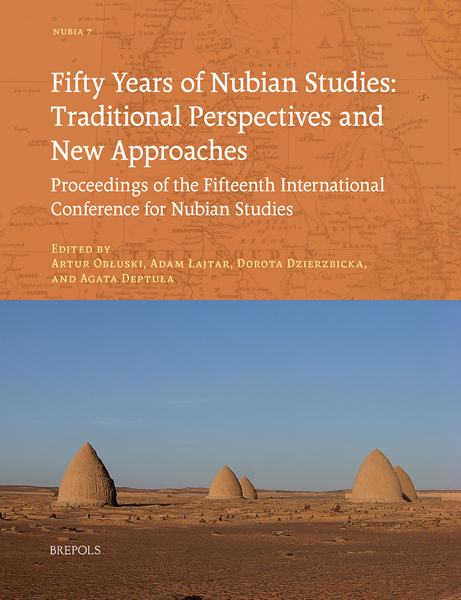
The proceedings of the Fifteenth International Conference for Nubian Studies present the latest research on the archaeology, history, and cultural heritage of the Middle Nile Valley, from the earliest kingdoms to the Christian and Islamic periods.
Artur Obłuski, President of the International Society for Nubian Studies and Director of the Polish Centre of Mediterranean Archaeology, University of Warsaw;
Adam Łajtar member of the Board of the International Society for Nubian Studies, Faculty of Archaeology, University of Warsaw;
Agata Deptuła and Dorota Dzierzbicka, Polish Centre of Mediterranean Archaeology, University of Warsaw.
All four editors are specialists in the study of Nubia and have long been involved in archaeological fieldwork and research in the Middle Nile Valley, including projects in Qasr Ibrim, Faras, Qasr el-Wizz, Dongola, Banganarti, Selib, the Fourth Cataract area, and Ghazali.
This volume gathers together the proceedings of the 15th International Conference for Nubian Studies, held at the University of Warsaw in 2022, exactly fifty years after the founding meeting of the International Society for Nubian Studies was held in the same city. This anniversary conference brought together scholars representing a wide range of disciplines engaged in the study of Nubia’s past: archaeology, history, art history, text studies, heritage studies, and the digital humanities.
The chapters presented here cover an extensive chronological and thematic spectrum, spanning from Nubia’s earliest history to the Christian and Islamic periods, as well as exploring the challenges of heritage preservation in modern Sudan. Grouped into thematic sections, the volume reflects the diversity and vitality of current research on the Middle Nile Valley: from field reports and new archaeological discoveries to studies on ritual, power, identity, and interregional contacts. It also highlights recent developments in digital documentation, bioarchaeology, and heritage management, illustrating how Nubian Studies have evolved and expanded in scope in the half century since their institutional beginnings in Warsaw.
List of Illustrations
Preface
The Oldest Chapter
1. Documenting Prehistoric Rock Art in Jebel Shaqadud, North-western Butana
Lenka Varadzinová, Jiří Unger, and Ladislav Varadzin
2. Current Research into the Early Holocene Occupation of Central Sudan: New Radiocarbon Dates from Jebel Sabaloka
Lenka Varadzinová, Ladislav Varadzin, Stanley H. Ambrose, Isabelle Crevecoeur, and Jan Novák
3. The ‘Fourth-Millennium BCE Gap’ in the Northern Dongola Reach Sequence: A Seeming Gap that Is Being Bridged
Olivier Langlois, Gilles Durrenmath, Hisham Khidir Ahmed Karrar, and Hassimi Sambo
4. Periodizing the Gash Group Sites of Eastern Sudan: Settlement Dynamics of the Third–Second Millennium BCE
Enrico Giancristofaro and Andrea Manzo
5. Funerals, Feasting, and Alliances: Paths to Complexity East of the Atbara in the Third and Second Millennia BCE
Andrea Manzo
Traditions, Customs, and Spirituality
6. The High Priests of Amun in Nubia at the End of the Ramesside Empire: Researches and Perspectives
Giacomo Cavillier
7. Frontality in Meroitic Graphic Communication: Function and Variation in Meaning
Kristina Hülk
8. Meroitic Funerary Amulets: Further Remarks on Interpreting the ‘Meroitization’ of Beliefs
Mahmoud A. Emam
9. The Old Nubian Astrological Treatise P.QI II 20 and the Tradition of the Zodiologia
Michael Zellmann-Rohrer
Perspectives on Nubian Societies and Daily Life
10. Exploring Aspects of Identity Through Grave Inclusions and Mobility in Kerma-Period Cemeteries near al-Qinifab
Lesley Gregoricka and Brenda J. Baker
11. Grave Re-entry in Ancient Nubia: A Case Study from Kerma-Period Cemeteries near al-Qinifab
Cearra Mihal, Brenda J. Baker, and Sidney G. Rempel
12. New Pot in the Kitchen: Case Study of a Cooking Pot from Wad Ben Naga and Reconsideration of a Group of Meroitic Bowls
Jiří Honzl
13. Multispectral and Digital Enhancement Evaluations of Meroitic-Period Tattooed Nubians
Kari A. Guilbault, Anne Austin, and Brenda J. Baker
14. Tracing Biology in the Bayuda: Insights from Medieval Ghazali (c. 680–1275 CE)
Robert J. Stark and Kendra Sirak
Power and Authority
15. Egyptian Kings at Buhen: Dynasties 0, 1, and 2
Maira Torcia
16. Thutmose III, Semna and Kumma, and Beyond: Models of Kingship on the Border of Kush
Emanuele Ciampini
17. Reflections on Demotic Graffiti at Dakka, Dendur, and Philae
Josefine Kuckertz
18. A Royal Legitimacy Crisis: The Case of Ergamenes/Arqamani I
Stanley Burstein
19. The Eparch of Nobadia: A Summary of a Workshop
Magdalena M. Wozniak, Alexandros Tsakos, and Robin Seignobos
Critical Historiographies
20. Where Were the Women? The UNESCO Rescue Campaign Revisited: A Gender Approach to the Nubian Campaign
Salomé Zurinaga
21. Wadi Halfa: Developing a Border City
Maria Costanza De Simone and Shadia Abdarabo Abdelwahab
Recent Fieldwork and Material Studies
22. Abu Erteila: An Updated Overview
Eugenio Fantusati
23. Newly Discovered Sandstone Chapel WBN 1100? Archaeological Research at the Northern Limit of Kom A at Wad Ben Naga
Vlastimil Vrtal
24. Natakamani and Beyond: Latest Discoveries and New Results from the Meroitic District at Jebel Barkal
Francesca Iannarilli
25. Abasseya Project: Remarks on B2500 (Jebel Barkal)
Montserrat Díaz-de-Cerio
26. Intaglio 613 of the Sudan National Museum: Study and Comments
Aminata Sackho-Autissier