Sociopolitical Structure and the Collapse of the Meroitic State in the Middle Nile Region
View publication
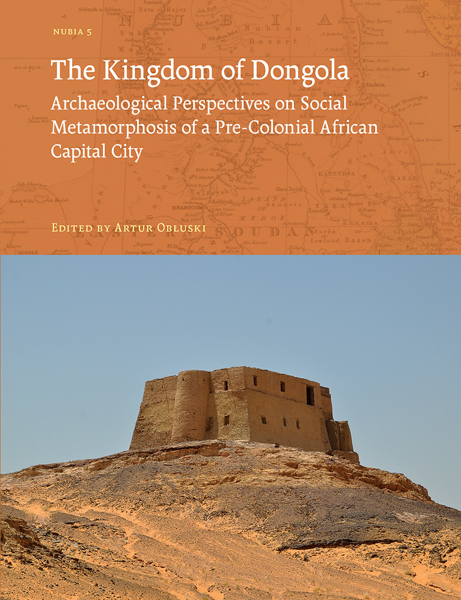
This book presents material emanations of social change of the community of Dongola, a precolonial African capital city.
Artur Obłuski was the Principle Investigator of the ERC StG UMMA project that gave birth to this book. He is interested in the transitional periods in history of the Middle Nile Valley, particularly processes of political, social and religious changes. He is director of the Polish Centre of Mediterranean Archaeology, University of Warsaw. He is a propagator of the idea of involvement of local communities in archaeological research and conrtibution of archaeology to communities development.
The site of Dongola, situated on the eastern bank of the Nile, functioned for more than a millennium, from the establishment of its citadel in the late fifth century CE to its abandonment in the eighteenth century ce. At its height, it served as the capital of the Christian kingdom of Makuria between the ninth and thirteenth centuries, embodying a distinctive political and religious centre. The rise of the Funj Sultanate along the Blue Nile in the sixteenth century introduced new regional dynamics, with the sovereigns of Dongola increasingly subsumed as vassals within this shifting political landscape, a period marked by significant changes in governance, urban life, and religious authority.
This volume examines these transitional centuries in medieval Nubia, focusing on the dissolution of state and ecclesiastical structures and the concurrent emergence of new political formations. Drawing on research conducted through the European Research Council Starting Grant project UMMA, which investigated spatial, social, and religious transformations within Dongola’s riverine community, the collected chapters explore multiple facets of urban metamorphosis. Through analyses encompassing space syntax, botanical and faunal assemblages, and diachronic and spatial studies of household inventories, the volume offers a comprehensive reassessment of the dynamic forces that reshaped this vital historical landscape.
List of Illustrations
1. Introduction
Artur Obłuski
2. Excavating ‘Our’ History: Old Dongola, Communities, and Excavations
Tomomi Fushiya
3. The Households and the Identities of the City Dwellers
Maciej Wyżgoł
4. Site Formation Dynamics, Refuse Management, and Assemblages from Post-Makurian Old Dongola
Lorenzo de Lellis
5. Arabic Paper Documents from Old Dongola: An Overview
Tomasz Barański
6. Magia Nubica: Investigating Christian and Islamic Magical Ostraca from Old Dongola
Agata Deptuła and Tomasz Barański
7. Plant Resources from Old Dongola: The Archaeobotany of Upper Nubia
Cristina Castillo Cobo and Dorian Q Fuller
8. The Plant Remains: Macrobotanical Evidence from the Fourteenth–Eighteenth Centuries CE
Mohammed Nasreldein
9. Animals in Dongola: A Reflection on Demographic Changes, Global Connections, and Local Politics in a Precolonial African City
Marta Osypińska
10. Technological Analysis of Ground Stone Tools from the Funj-Period Old Dongola
Agnieszka Ryś-Jarmużek
11. Detecting Local and New Identities through the Textile Perspective
Magdalena M. Wozniakis
12. Bioarchaeological Investigations of the Old Dongola Landscape During the ERC UMMA Project
Robert J. Stark
13. Ceramic Evidence for Long-Distance Trade Between the Middle Nile Valley and the Ottoman Empire from Old Dongola
Katarzyna de Lellis-Danys
14. Preliminary Results of Micro- and Mesoscopic Analysis of Old Dongola Pottery Fabrics
Bogusław Franczyk