Archetypal Narratives. Pattern and Parable in the Lives of Three Saints
View publication
How Early Christians transformed the cross from an instrument of death into a powerful divine sign shaping the identity and life of believers
Robert Button is an honorary research fellow of the University of Exeter and an associate lecturer with the Open University, where he teaches on modules in religious studies. He holds doctorates in religion and theology (University of Exeter) and in sociology (University of Leeds) and has published in international journals in the fields of theology and social theory, including ‘Studia Patristica’, and ‘Theory, Culture & Society’.
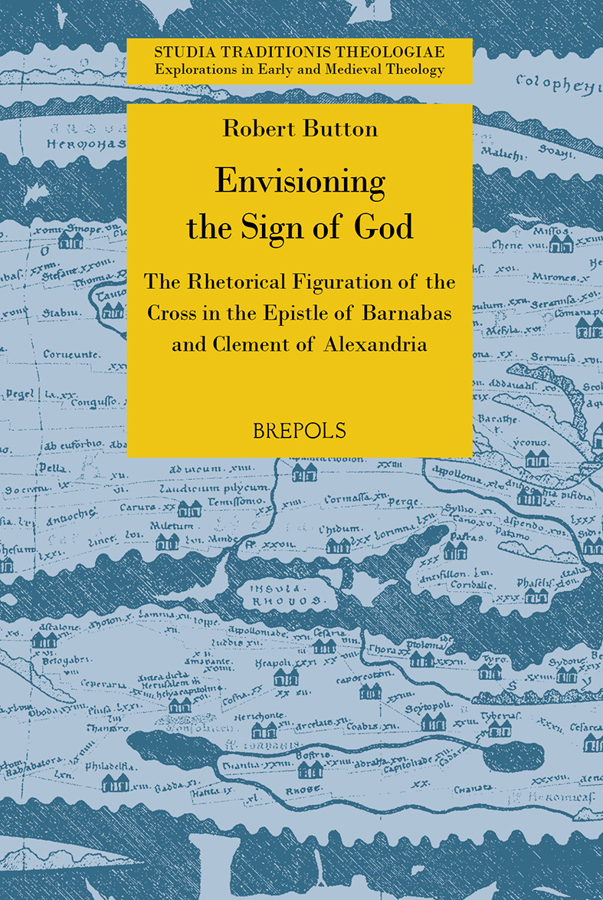
In ‘Envisioning the Sign of God’, Robert Button explores the rhetorical imaging of the cross as the sign of Jesus in the early Christian text known as the ‘Epistle of Barnabas’ and in the writings of Clement of Alexandria. He draws attention to how these early Christian writings evoke and ‘figure’ the cross as a geometric and material form which can be seen in the natural and cultural world, and which mediates divine communication and presence. Focussing on an under-studied number symbolic exegesis where the cross is pictured in the very orthography of scripture, and on examples where the cross is imaged in physical performances in scripture and in scenes from Greek epic and tragedy, this study develops a semiotic hermeneutical lens which traverses text, image, and thing, to foreground the role of the cross as a rhetorical image in shaping Christian imaginaries. This work makes an original contribution to the study of early Christian literature and to the understanding of the cross in early Christian theology, developing a novel methodology which engages trends in material religion and performance studies to highlight and explore the semiotic, material, and performative dimensions of the figurative images of the cross evoked by Christian rhetoric. It considers the role of these images in strategies of Christian formation and in theological perspective it argues that the imaging of the cross as a rhetorical strategy relates to incarnational theology, as the cross emerges as the sign of Jesus, himself the incarnate sign of God.
Chapter 1. Introduction
Part I: Semiosis, Shape, and Presence
Chapter 2. Genesis 14:14, Number Symbolism, and the Tau
Chapter 3. The Cross, Baptism, and Renewal in Barnabas
Chapter 4. Clement of Alexandria: Arithmetic, Geometry, and the Presence of the Sign
Chapter 5. The Cosmic Cross and Contemplative Ascent
Part II: Performance, Mediation, and Embodiment
Chapter 6. Prophetic Performances in Scripture
Chapter 7. Clement’s Cross in Homeric Performance: Odysseus on the Mast
Chapter 8. The Cross in Euripidean Tragedy
Chapter 9. Conclusion