Acts of John
View publication
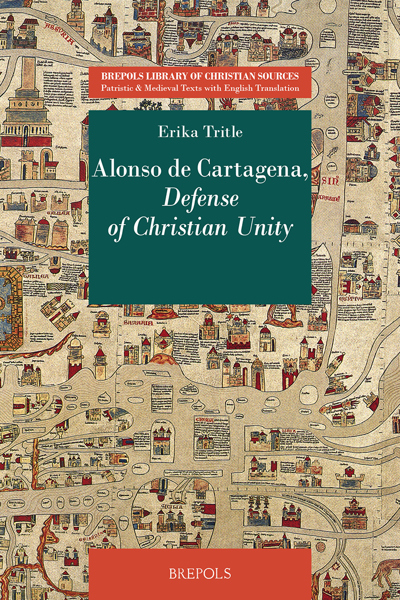
The English translations of Alonso de Cartagena’s Defense of Christian Unity.
Erika Tritle is a scholar of the history of Christian thought and Assistant Professor of Religious Studies at Coastal Carolina University. In her teaching and research, she explores religion at the intersection of communities and identities. She served as a postdoctoral fellow at the Center for the Study of Conversion and Inter-Religious Encounters at Ben Gurion University of the Negev and earned her PhD in History of Christianity from the University of Chicago Divinity School.
Alonso de Cartagena, bishop of Burgos in the Spanish kingdom of Castile, wrote the Defense of Christian Unity in 1449-50 in response to a violent uprising in Toledo that targeted conversos—baptized Jews and their descendants. While responding directly to adversaries’ claims about the perpetual, stiff-necked, deicidal animosity toward “Old” Christians that inevitably characterized conversos of Jewish lineage, Cartagena crafted one of the most articulate defenses of the conversos as legitimate Christians not in spite of but precisely because of their kinship with the Apostle Paul according to the flesh. The first-ever English translation of the Latin treatise appears in this volume, with a side-by-side Latin edition, along with the first English translation of the Castilian (Spanish) Appeal and Supplication of the Bachelor Marcos García de Mora, the spokesman of the conversos’ enemies, as an appendix. On the cusp of the era of European exploration and colonization, we hear Spanish Christian authors arguing about the nature of Israel and its relationship to the Church, the authority to read biblical and legal texts, the relationship between religious and national identity, the meaning of baptism, and the prospect that spiritual and cultural characteristics could be inherited in the body and affect civic and Christian status for generations. These texts allow readers to explore such urgent theological and political questions as they emerged out of the converso debate and reflect on how they appear in the present day, when we have yet to settle the relationship between the spirit and the flesh.
I. Acknowledgements
II. Introduction
A. 1391 and the Rise of a “Converso Problem”
B. Toledo, 1449
C. Anti-Converso Arguments: The Appeal and Supplication
D. Alonso de Cartagena: A Biographical Sketch
E. Structure of the Defense of Christian Unity
F. Selected Intertwining Themes in Cartagena’s Defense of Christian Unity
1. Hermeneutics: Who is a Jew? Who is a Christian?
2. Race
3. Nobility
4. The Legacy of the Apostle Paul
5. Political Theology
6. Unity
7. Purity and Cleanness
8. Covenant and the Place of the Jews
9. Jewish Sin, Jewish Lineage, and the Problem of the Will
i. The Nature of Jewish Flesh
ii. The Will and the Jews’ Sin
iii. Cartagena and Espina on Jews and the Will
10. Christians, Jews, and Muslims
11. The Work of Baptism
G. Manuscripts
H. Editions
I. Translation [reflection on method and choices]
J. Annotated Bibliography
K. Abbreviations
III. Defense of Christian Unity: Latin edition with English translation
A. Prologue
B. Part I
C. Part II
1. Theorem 1
2. Theorem 2
3. Theorem 3
a. Subarticle 1
b. Subarticle 2
c. Subarticle 3
D. Part III
E. Epilogue
IV. Appendix: Appeal and Supplication of the bachelor Marcos García de Mora in his favor and of Pero Sarmiento and of this city of Toledo in the time of the king don Juan the second: English translation
V. Index