La Clemenza di Tito di Mozart. I primi trent'anni (1791-1821)
View publication
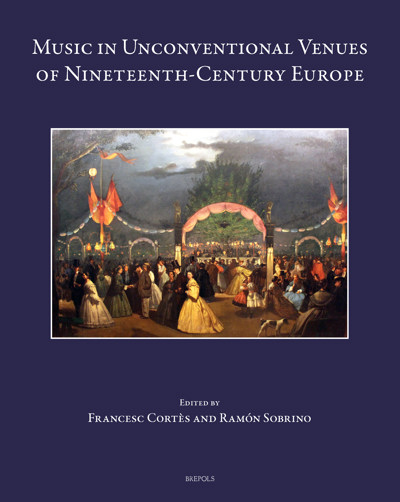
This volume provides a thorough overview of musical performances held in non-traditional venues during the long nineteenth century
Francesc Cortès is Professor of Musicology at the Autonomous University of Barcelona (UAB). His research has focused on contemporary Spanish music, focused in the operatic repertoire. He has edited operas such as «La Fattucchiera» (Cuyás, 1838), «Los Pirineus» (Pedrell, 1891), the catalan «L'aplec del Remei» (Clavé, 1858), among others. He has researched the various facets of Felip Pedrell, a key figure, and directs the cataloging of the Archive of the Societat del G. T. del Liceu (Barcelona).
Ramón Sobrino is Professor of Musicology at the University of Oviedo (Spain), where he has directed forty doctoral theses. His main field of research is music analysis, with specialisation in analytical methodologies, and Spanish music. He has published symphonic works by Monasterio, Bretón, Marqués Chapí, Torrandell, Zubiaurre, Sarasate, and others and edited Spanish Lyric works by Barbieri, Arrieta, Gaztambide, Chueca, Serrano and Rodrigo.
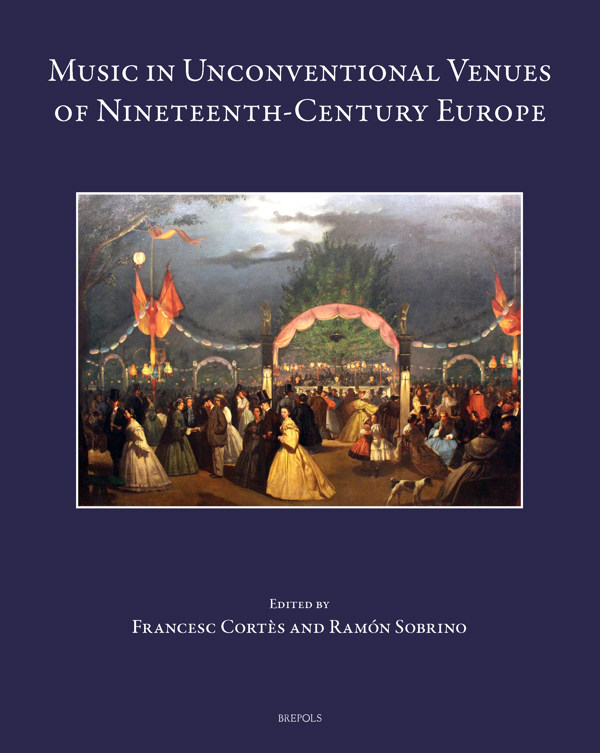
During the 19th century, music thrived in a variety of private and public spaces beyond the confines of theatres and concert halls throughout Europe. This volume decisively examines these unconventional venues, including outdoor locations such as gardens, municipal parks, squares, and fairs, alongside indoor environments such as spas and casinos. With over eighteen chapters, this collection provides a comprehensive overview of musical activities across diverse urban settings and social contexts during the long 19th century. The narratives take place in vibrant cafes, gardens, amusement parks, and seaside resorts, significantly highlighting the festive periods of Carnival. Furthermore, this volume underscores the critical role of music in exhibition spaces, equestrian arenas, the world of the circus, and military parades. By delving into these diverse spaces, we gain valuable insights into the musical landscape, where traditional concert hall and opera house audiences interacted with amateurs, dilettantes, and working-class individuals who often lacked formal education. This exploration encompasses 19th-century Europe, focusing on key Romantic cities such as Paris, Vienna, Amsterdam, Brussels, Lisbon, Madrid, and Barcelona, while also considering other alternative urban contexts like Astorga, Pula, and the Austrian Riviera in Abbazia. Additionally, the outlook is completed by an authoritative study of a circus itinerary in 19th-century England.
Francesc Cortés i Mir – Ramón Sobrino
Preface
Music in Diverse Urban Settings: Socialization and Amusement
Emilio Casares Rodicio
Un espacio alternativo a la música de salón: el café y sus músicas
Julia Mária Martínez-Lombó Testa
La Sociedad Recreativa del Casino de Astorga: paradigma de espacio musical de una ciudad burguesa de provincias de la España de la segunda mitad del siglo XIX
Amélie Addison
Performing with a Monster Menagerie: A Circus Bandsman’s Perspective
Negotiating Spaces: Music Repertoires from the Theatre to the Equestrian Arena
William Osmond
« J’peux pas, j’ai kermesse! »: French Opera and comédie-vaudeville in the Amsterdam Kermis (1830-1839)
Rachel Becker
Unconventionally Conventional: Instrumental Music in the Opera Theatre
Noriko Kamiyama
‘Music Festival of the Future’ at the Equestrian Arena in Ballenstedt
Étienne Jardin
Concert Venues in 19th-Century France: An Overview of Cuckoo’s Nests
John D. Wilson – Cheston Humphries – Mary Kirchdorfer
A ‘City of Music’ without a Concert Hall: Concert Life in Vienna around 1800
Military Orchestras and Bands: Promoting Music for Education and Entertainment
Gloria A. Rodríguez-Lorenzo
Workhouses Bands in 19th-Century Spain: Music, Education and Social Inclusion
Lada Duraković – Marijana Kokanović Marković
Klänge aus Pola: Open-Air Concerts of the Naval Orchestra under the Baton of Franz Lehár
Vjera Katalinić
A Military Ensemble as a Spa Entertainer: The Case of the 79th Infantry Regiment Orchestra
Outdoor Music Spectacles in the Civic Cultural Agenda
Joana Peliz
Del Convento de las Capuchinas de París a las fincas y plazas de toros de la Península Ibérica: la música en las exhibiciones fantasmagóricas y aerostáticas de Étienne-Gaspard y Eugène Robertson
Clément Noël
Extending Berlioz’s Utopia? Gustave Charpentier and the Architectural Music of the Couronnement de la Muse
Jan Dewilde
Markets and Squares as Concert Venues in 19th-Century Flanders: Open-Air Cantatas of Peter Benoit (1834-1901)
Musical Repertoires in 19th-Century Gardens across the Iberian Peninsula
Francesc Cortès
Los conciertos en los Jardines de Euterpe y los Campos Elíseos de Barcelona (1859-1874): tránsito de repertorios entre la ópera y la música popular
Rui Magno Pinto
An Unprecedented Musical Clash at Lisbon’s Gardens: The Promenade Concerts of the Associação Música 24 de Junho and of the Associação de Professores de Música
María Encina Cortizo
El furor por el baile en el Madrid de mediados del siglo XIX: bailes campestres, sociedades y jardines
Ramón Sobrino
Conciertos sinfónicos y teatro lírico en los jardines madrileños (1864-1868)
Abstracts and Biographies
Index of Names