Bonds and Boundaries among the Early Churches
View publication
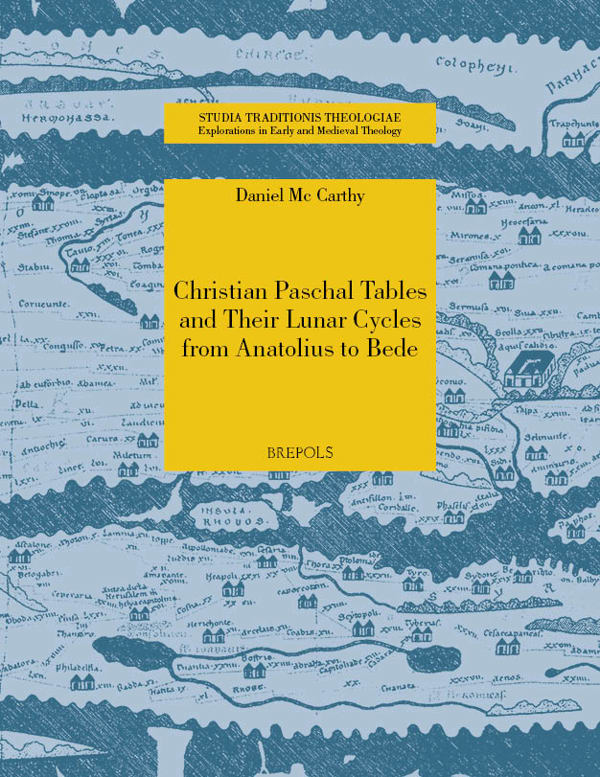
This is the first comprehensive published account of the evolution of the Christian use of a 19-year lunar cycle to schedule Easter, from Anatolius’ introduction of the cycle in the third century to Bede’s 532-year continuation of it in the eighth century.
Daniel Mc Carthy is a Fellow Emeritus and retired Senior Lecturer, Department of Computer Science, Trinity College, Dublin, and a Member of the Royal Irish Academy. He has published articles and books dealing with the Paschal computus, chronicles and annals and their chronology, historical astronomical observations, monastic tonsure, mathematical tables, and the Book of Kells.
The events of Jesus’ Crucifixion and his Resurrection three days later provide the basis for Christians’ belief in redemption and an existence after death. Consequently, the celebration of the events of Jesus’ Passion represents the most important feast in the Christian calendar, designated Pasch, or Easter in English. The four Gospels correlate the Crucifixion with the Jewish feast of Passover, celebrated at the time of the spring full moon, so initially the Passover full moon determined the approximate date of the Christian celebration. However, as Christianity spread beyond Palestine it became difficult for the dispersed Christian communities to synchronize their celebration of Pasch.
In AD 269, Anatolius, bishop of Laodicea in modern Syria, established an accurate 19-year lunar cycle to predict the date of the spring full moon for future years. In circa AD 309, Eusebius, bishop of Caesarea, used Anatolius’ 19-year lunar cycle to construct a table to schedule Pasch for the future years. In AD 328 Athanasius, bishop of Alexandria, modified Anatolius’ lunar cycle by advancing all nineteen full-moon dates by exactly two days, and this cycle was continued by his episcopal successor, Theophilus. In circa AD 412 the Alexandrian mathematician, Annianus, further modified this cycle by advancing its saltus by three years. Annianus’ cycle was quickly adopted by Theophilus’ episcopal successor, Cyril, who misrepresented that Annianus’ cycle had been authorized by the Council of Nicaea. This was the cycle that prevailed in the Western Church until Pope Gregory reformed the calendar in 1582, and this book comprehensively documents for the first time the evolution of these Paschal cycles.
I. The Christian adoption of lunar cycles to schedule their Pasch
II. Published reconstructions of Anatolius’ 19-year Paschal table
III. Revision of the reconstructed Paschal table of Anatolius’ De ratione paschali
IV. Paschal tables deriving from Anatolius’ 19-year cycle
Anatolius’ De ratione paschali, AD c.271
Eusebius of Caesarea’s Paschal table, AD c.309
Athanasius’ Festal letters and the Alexandrian Index, AD c.380
Theophilus’ 100-year Paschal table, AD c.385
Annianus’ 532-year Paschal table and his 19-year lunar cycle, AD c.412
V. References to Paschal tables employing 19-year lunar cycles, AD 418–455
Cyril’s letter to the Council of Carthage, AD 418
Cyril’s 114-year Paschal table of AD c.428
Paschasinus’ Ep. ad Leo of AD 443
Leo and Proterius and the Pasch of AD 455
VI. Translation and adaptations of Annianus’ Paschal table, AD c.445–c.457
A Latin translation of Annianus’ Paschal table, AD c.445
The Gaulish preface to a 95-year Paschal table, AD c.456, and its Iberian recension
The 532-year Paschal table of Victorius of Aquitaine, AD 457
VII. Continuations of the adaptations of Annianus’ Paschal table, AD 525–c.630
Dionysius Exiguus’ Paschal epistolae, AD 525
The Ravenna Rota – AD c.526
Leo the monk’s Ep. ad Sesuldum archidiaconum – AD 532
Isidore, bishop of Seville, Etymologiae 6,17 – AD c.630
VIII. Dionysius to Bede: Western use of adaptations of Annianus’ Paschal table, AD 525–725
The papal attitude to Victorius’ marginal dates avoiding 24–25 April
Interpreting references to Victorius’ Paschal table, AD 532–721
The Paschal table sent by pope Gregory with Augustine’s mission to Britain, AD 597
The Anglo-Saxon church’s reception of Dionysius
Bede’s account of Dionysius and Victorius in DTR
IX. The evolution of 19-year Paschal lunar cycles, AD 269–457
Appendices
Bibliography