Mediaeval and Renaissance Latin Translations and Commentaries: Annotated Lists and...
View publication
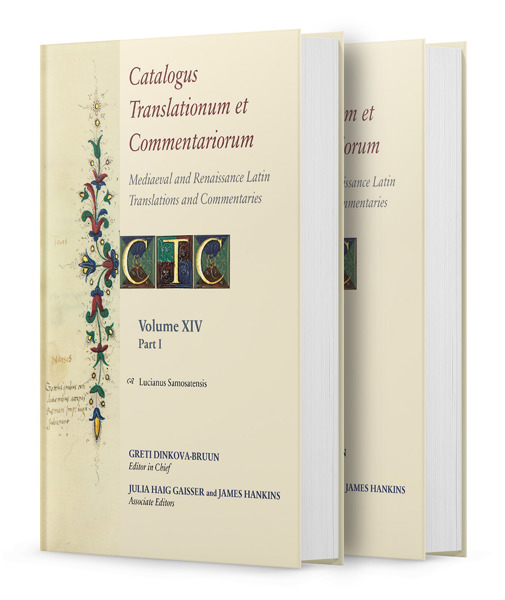
Continuing its undeniable contribution to the study of the transmission and reception of Greek and Latin texts, the fourteenth volume of the Catalogus Translationum et Commentariorum, edited by Greti Dinkova-Bruun, offers an exceptional overview of the fortune of Lucian of Samosata from Antiquity to the early modern period. The detailed information on manuscripts, printed editions, commentaries, and translations both into Latin and the vernacular assembled by Keith Sidwell is complemented by extensive quotations of paratextual material, thus providing remarkable insight into the complexity of the reception of Lucians works. The volume opens with a comprehensive Introduction, in which an account of diverse approaches is presented, and concludes with a Conspectus of Translations, useful for navigating the large amount of the material gathered. Overall, it is a monumental contribution to our understanding of the sophists pedagogical and literary influence, from Byzantium to early modern Europe, and will undoubtedly become an indispensable reference work for any student of the classical tradition. Maria Lusa Resende, Universidade Catlica Portuguesa
Keith Sidwells Lucianus Samosatensis for the Catalogus Translationum et Commentariorum is a landmark achievement in the study of the classical tradition. Confronting a corpus of exceptional scale and complexity, Sidwell combines meticulous bibliographical precision with a clear, highly usable structure. The volume proceeds in broadly chronological sequence while grouping translations and commentaries by individual scholars, enabling readers to trace Lucians afterlife not only work by work, but also through the careers, intellectual networks, and scholarly environments that carried his writings across centuries. Sidwell follows Lucian from the earliest stages of Greek learning in Renaissance Italy, where his works served as key classroom texts, through the explosion of Latin translation, commentary, and print circulation in the fifteenth and sixteenth centuries, and into the wider phenomenon of Lucianism in European literary and cultural history down to the present. Along the way, he assembles and clarifies an extraordinary body of evidence: hundreds of manuscripts, hundreds of printed editions, and a dense web of paratexts through which early modern readers interpreted Lucians value and purpose. The books detailed conspectuses make visible at a glance which works circulated where, in what languages, and under whose names, offering an indispensable map of a tradition in which texts often travelled independently and translators and commentators worked across decades. Sidwells most important contribution, however, lies in transforming immense documentation into interpretive clarity: correcting misattributions, refining dates and provenance, and illuminating the pedagogical and scholarly conditions that made Lucian central to the revival of Greek. With its expansive, carefully cross-referenced catalogue strengthened by links to digitized copies this volume stands as both a foundation and a gateway for future scholarship in Classics, Medieval and Renaissance Studies, Translation History, and Reception research. Ioannis Deligiannis, Democritus University of Thrace
Greti Dinkova-Bruun is a Fellow and Librarian of the Pontifical Institute of Mediaeval Studies, Toronto. She has edited Alexander Ashbys Opera Poetica for the Corpus Christianorum Continuatio Mediaevalis (2004) and The Ancestry of Jesus: Excerpts from Liber Generationis Iesu Christi Filii Dauid Filii Abraham for Toronto Medieval Latin Texts (2005). Her numerous articles have appeared in Mediaeval Studies, Viator, Sacris Erudiri, Mittellateinisches Jahrbuch, and Archives dhistoire doctrinale et littraire du Moyen ge, among other journals.
Julia Haig Gaisser is Eugenia Chase Guild Professor Emerita in the Humanities and Professor Emerita of Latin at Bryn Mawr College. Her article on Catullus appeared in CTC 7 in 1992. She is the author of Catullus and His Renaissance Readers (1993), The Fortunes of Apuleius and the Golden Ass: A Study in Transmission and Reception (2008), and Catullus (2009); she is also the editor and translator of Pierio Valeriano on the Ill Fortune of Learned Men: A Renaissance Humanist and His World (1999) and Giovanni Giovanio Pontanos Dialogues: Charon and Antonius (2012).
James Hankins is Professor of History at Harvard University and founder and general editor of the I Tatti Renaissance Library, published by Harvard University Press. He is the author of, most recently, Virtue Politics: Soulcraft and Statecraft in Renaissance Italy (2019) and Plato in the Italian Renaissance (1990; Italian translation, 2009), and editor of The Cambridge Companion to Renaissance Philosophy (2007) and (with Fabrizio Meroi) The Rebirth of Platonic Theology (2013), as well as editor and translator of Leonardo Brunis History of the Florentine People (20012007) and editor of Marsilio Ficinos Platonic Theology (20012006).
Founded in 1945 by P. O. Kristeller, the Catalogus Translationum et Commentariorum has evolved over time to reflect developments in the field of reception studies; each article begins with an overview of a Greek or Latin authors reception and contains detailed and accurate information about manuscripts and early printed editions along with copious quotations of paratextual material. Volume 14 is dedicated to the vast literary production of a single Greek author, the Syrian-born satirist Lucian of Samosata. The highly original and often surprising texts of Lucian have inspired a rich tradition of translations, commentaries, and studies throughout the centuries.
Preface, by Greti Dinkova-Bruun
Preface to Volume I, by Paul Oskar Kristeller
General Bibliography
Abbreviations
Introduction and Acknowledgements, by Keith Sidwell
Greek Authors
Lucianus Samosatensis, by Keith Sidwell (University College Cork and University of Calgary)
Index of Manuscripts
Index of Translators and Commentators
Index of Printers
General Index
Index of Ancient Authors Treated in Volumes IXIV