Ειρηνάρχης
View publication
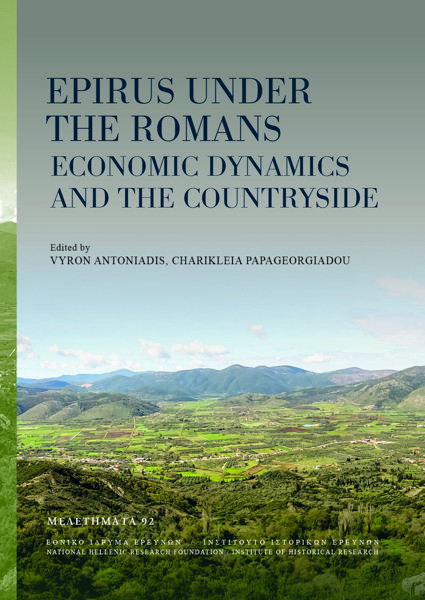
The edited volume Epirus under the Romans: Economic Dynamics and the Countryside reassesses Epirus, a region long dismissed as peripheral within the Greco-Roman world. Moving beyond narratives of decline after 167 BC, the volume draws on archaeological and historical evidence to explore how the region was transformed, adapted and integrated into Roman economic structures.
The chapters investigate themes including the development of settlements and fortified centres before the Roman conquest, and the subsequent restructuring of rural territories through land division and the exploitation of agricultural and pastoral resources. They also examine the emergence of villae rusticae and large agricultural estates, and the foundation of Nicopolis as a dominant urban and economic hub. Case studies address trade and monetary circulation, shifting patterns of rural investment, and, in some areas, the resilience of inland and coastal economies. Further contributions draw on material culture, including mosaics, and on epigraphic evidence, while also developing spatial approaches to rural connectivity and widening the perspective through comparative discussion beyond the region.
Taken together, the volume demonstrates that Epirus was defined not by marginality within the Roman world, but by the interaction of its people and landscape, where pastoral and agricultural traditions were reconfigured within the wider economic systems of the Roman Mediterranean.
List of Authors
Introduction
PANAGIOTIS N. DOUKELLIS
Economie et societe en Epire romaine: les antécédents
FRANK DAUBNER
What to Do With Butrint? An Epirote Tribe Obtains an Urban Centre
ADOLFO J. DOMINGUEZ
Organisation of the Territory and Economy in Hellenistic Epirus
SOPHIA ZOUMBAKI
Rome’s Economic Policy in Western Greece in the 3rd and 2nd c. BC: From the Longstanding Italian Interests in the Regionto the Case of Ambracia
CHARIKLEIA PAPAGEORGIADOU
Romans in Western Greece. What About Money?
ATHANASIOS D. RIZAKIS
Large-Scale Farming in Greece Under the Roman Empire: The Villa as a Symbol of Economic, Social and Cultural Change in the Greek Countryside
VASSILIKI LAMPROU, KASSIANI LAZARΙ, ANTONIA TZORTZATOU
Farmsteads and Rural Villas in Roman Thesprotia. Foundation, Distribution and Character
ΙOULIA K. KATSADIMA, YPATIA FAKLARI, GUILLERMO PASCUAL BERLANGA
Sellades: Preliminary Observations on an Agricultural Complex in the Area of the Ambracian Gulf in Roman Times
GEORGIA PLIAKOU
The Hinterland of Epirus During Roman Times. Rural Settlements in the Molossian Territory
VASSILIKI GIANNAKI, ANASTASIA GIOVANOPOULOU, LEONIDAS LEONTARIS, IULIA STAMOU
Μια ρωμαϊκή αγρέπαυλη στην Κρανούλα Ιωαννίνων
VYRON ANTONIADIS
Beyond the Grid: Rural Spatial Organisation and Connectivity in the Territory of Nicopolis
THALIA KYRKOU
Ψηφιδωτά από αστικές οικίες και αγρεπαύλεις στη ρωμαϊκή Ήπειρο
GEORGE A. ZACHOS
Roman Aitolia: The Wind of Change
MILENA MELFI
Why Another Hadrianopolis?
DIMITRIS N. SAKKAS
To Set It Right. The Restoration and Dating of SEG 24, 423 and Its Associated Fragments From Nicopolis
Tables of Figures
Index