Early Music Pedagogy Then and Now
View publication
This book offers a new account of madrigal culture at the intersection of sound, space, and society
Stefano Lorenzetti is Director of the Vicenza Conservatory and a distinguished musician-musicologist. Trained in organ and harpsichord with K. Gilbert, he earned his Ph.D. at the European University Institute (Florence). His research and recordings explore early modern musical practices, memory, and noble identity, including major monographs with Olschki and LIM. A former fellow at the Italian Academy for Advanced Studies in America (Columbia University), he has lectured and performed widely across Europe, USA, and major academic institutions.
Elisa Sala is History of Architecture Associate Professor at the University of Brescia. Her research focuses on historic built heritage in Lombardy and on architectural culture between the late sixteenth and early twentieth centuries. She has investigated the relationship between music and architecture. She participates in national and international research projects, and serves on the doctoral board of the Ph.D. programme Musical Heritage and Soundscapes at the Conservatory of Brescia, and has authored scholarly publications.
Livio Ticli is a musicologist, singer and player (keyboards and harp). He teaches Basso Continuo, Historical Singing and Ornamentation at the Istituto Italiano di Musica Antica (co-chairing Brescia Early Music Department); Musicology at the Conservatories of Trapani and Brescia, and improvisation at Vicenza Conservatory. He collaborates with editorial boards such as the Tasso-in-Music Project (Massachusetts and Stanford University), and he is general editor of the book series ‘Antichi Maestri’ (LeMus) and ‘Musica Incarnata’ (Brepols).
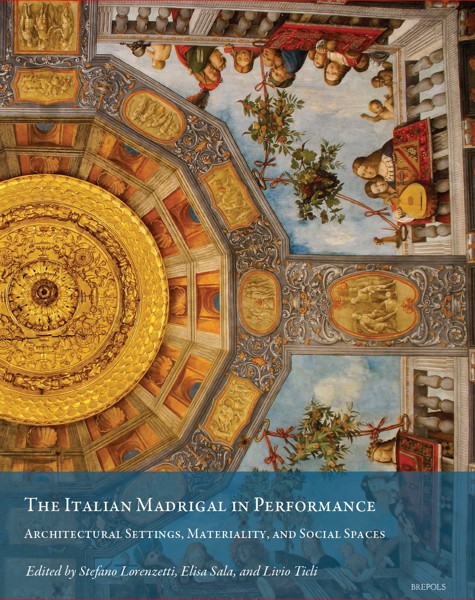
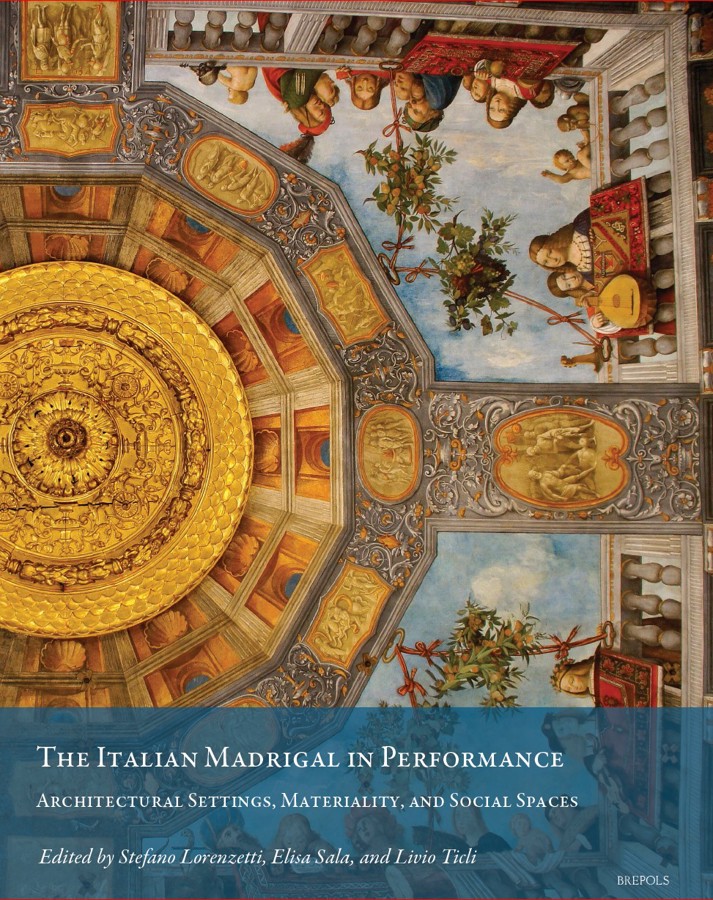
The volume rethinks the Italian madrigal not as a self-contained score but as a socially situated performance ecology shaped by bodies, rooms, objects, images, institutions, and relations of power. Bringing together musicology, architectural history, art history, and performance studies, the volume investigates how madrigals sounded, circulated, and acquired meaning across courts, academies, domestic interiors, gardens, banqueting halls, and urban ceremonial settings in Renaissance and early Baroque Italy. Rather than treating space as a passive backdrop, the chapters show it to be an active agent in musical production: acoustic, symbolic, affective, and political. They explore how singers, instrumentalists, patrons, listeners, collectors, and students animated the madrigal through voice, gesture, ornament, pedagogy, devotion, sociability, ritual, and acts of translation and adaptation. From Rome and Ferrara to Naples and Brescia, the studies reveal the madrigal as a mobile medium that crossed boundaries between public and private, elite display and domestic practice, sacred observance and secular pleasure, textual artefact and embodied event. By foregrounding performance, sensory experience, material culture, and the social lives of music, this book offers a new account of madrigal culture at the intersection of sound, space, and society, recasting one of early modern Italy’s most influential genres as a dynamic practice of making meaning in and through place.
Stefano Lorenzetti, Elisa Sala and Livio Ticli, Introduction
1. The Madrigal in Practice: Materiality, Action, and Performance
Stefano Lorenzetti, What does a Madrigal do? Places, Spaces and Performance Practices of the Italian Renaissance Madrigal in Musica Secreta Contexts
Richard Wistreich, The Social Materiality of Italian Madrigals in Practice
Livio Ticli, Integrating Voices and Instruments: Performance Practices in Sixteenth-Century Italian Madrigals
2. The Madrigal at Home and in the City: Domestic, Urban, and Civic Spaces
Galliano Ciliberti, Il madrigale a Roma nei luoghi del Caravaggio. Spazio urbano, collezionismo e ‘patronage’ tra Cinquecento e Seicento
Barbara Bettoni, Playing and Singing at Home. Domestic Interiors, People and Objects for Music Practice in Early Modern Brescia
Marcello Mazzetti, Intimate Echoes: Composition and Domestic Performance Practices of Madrigals in Cinquecento Brescia
3. Staging the Madrigal: Ephemeral Architectures, Banquets, and Monumental Spaces
Elisa Sala, «Tutto ombra, sogno, chimera, fittione, mettafora e allegoria»: The Banquet at the Este Court of Alfonso I between Architecture and Music
Letizia Barozzi, «El tribunal de le donne». La musica per le nozze di Girolamo Martinengo e la Sala delle Dame di Moretto a Brescia
Kate Van Orden, Ephemeral Performances, Monumental Spaces: A Madrigal by Nanino and the Sistine Chapel in S. Maria Maggiore
4. Making, Circulating, and Recasting the Madrigal
Philippe Canguilhem, Madrigals in Letters, Madrigals and Letters: From Manuscript to Print
Maddalena Bonechi, Novità e/o persistenza nelle ‘Nuove Musiche’ di primo Seicento? Il caso dei «madrigali per cantar nel chittarrone» di Salomone Rossi (1600)
Marco D’Acunzo – Marina Lucia, Madrigali come strumenti didattici nei conservatori di musica napoletani tra il XVII e XVIII secolo
Abstracts and Biographies
Index of Names