Writing Distant Travels and Linguistic Otherness in Early Modern England (c. 1550–1660)
View publication
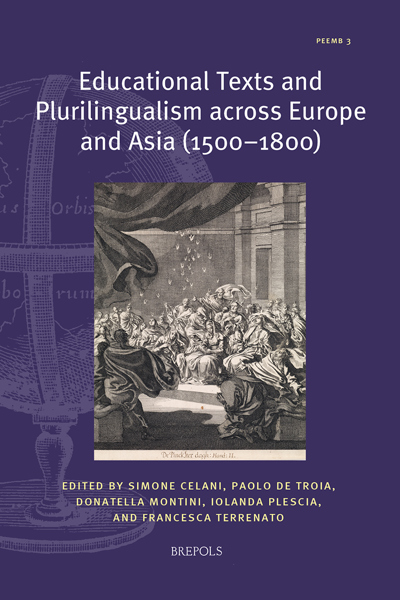
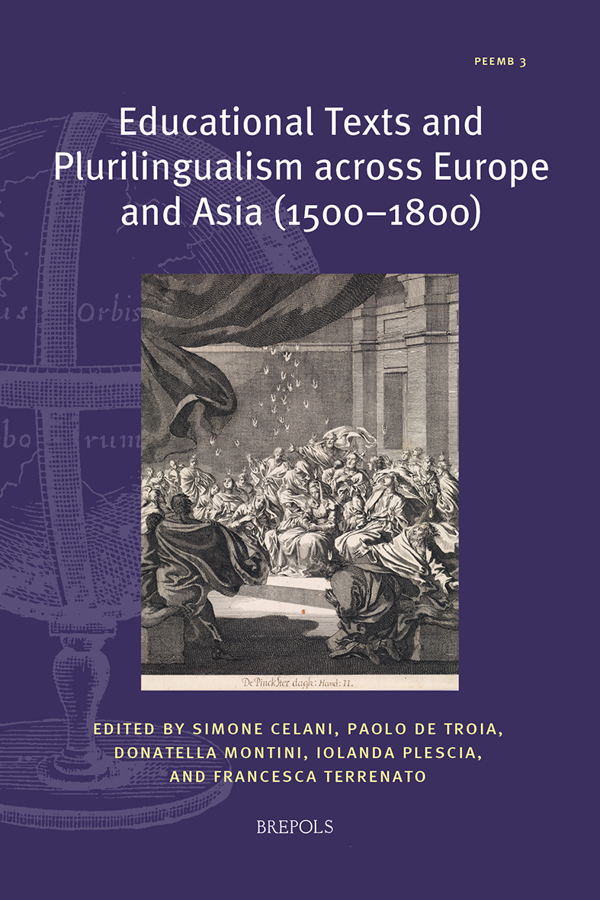
The volume aims to address linguistic, methodological, and cultural concepts related to language learning and teaching practices in the early modern period, and will consider both European circulation among national vernaculars, as well as a centrifugal trajectory towards East Asia.
Simone Celani is Full Professor at Sapienza University of Rome, specializing in linguistic historiography, translation studies, contemporary philology, and Lusophone African studies, with a focus on Portuguese-speaking languages, literatures, and cultures.
Paolo De Troia is Associate Professor of Chinese Language and Literature and Chinese Philology at Sapienza University of Rome. His research focuses on the history of Sino-European cultural and scientific exchanges, with particular attention to missionary sources, the transmission of geographical and scientific knowledge, historical lexicography, translation, and the development of modern Chinese terminology. He has published extensively on Jesuit and other missionary writings in China, including studies and annotated translations of works by Giulio Aleni and Ludovico Buglio. He is Associate Member of the Institute of History of Mediterranean Europe of the Italian National Research Council (CNR) and serves on the Board of the Italian Association for Chinese Studies. He has held research and teaching positions in China, including at Peking University and Beijing Foreign Studies University, and has been involved in numerous international research projects on Sino-European intellectual and cultural exchanges.
Donatella Montini is Full Professor of English Language and Translation at Sapienza University of Rome, Italy, where she teaches history of English, stylistics and political linguistics. She has published extensively on early modern English language teaching and translation. She has authored a volume on English contemporary stylistics (La stilistica inglese contemporanea. Teorie e metodi,). She co-edited a book on Queen Elizabeth I’s language and style (Elizabeth I in Writing. Language, Power and Representation in Early Modern England), and a book on the use of non standard language in fictional texts (The Dialects of British English in Fictional Texts). Her most recent publication is John Florio: Bilingualism, Style and Mediation.
Iolanda Plescia teaches English at Sapienza University of Rome where she directs the international MA programme in English and Anglo-American Studies. She was formerly President of the Italian Association of Shakespearean and Early Modern Studies (2021-2024) and is a national representative with the Italian University Council (CUN). Among her research interests are Shakespeare’s language, the history of the English language, the history of Italian-English translation, and literary translation, with special regard to the early modern age and the twentieth century.
Francesca Terrenato is Associate Professor of Dutch Language and Literature at Sapienza University of Rome. Among her research interests are early modern Dutch culture and its global networks, and emblematics.
The early modern period witnessed the development, enrichment, and standardization of vernacular languages, often in pursuit of linguistic and national homogeneity. At the same time, it was an age of mediators, travellers, translators, missionaries, and merchants, and multilingual encounters flourished, driven by the desire to learn, translate, and borrow from other languages.
These issues are central to any exploration of the encounter between languages and cultures in early modernity. This volume addresses the linguistic, methodological, and cultural concepts related to language learning and teaching practices, and considers both the circulation of texts among European vernaculars and its extension towards East Asia. Specific text types — grammars, dictionaries, conversation manuals, multilingual parallel texts, language-teaching manuals, emblems, and letters, as well as illustrated marginalia — are examined in order to explore interlingual and intercultural exchanges. The volume also looks at the points of contact between Europe and Asia where the activities of missionaries, merchants, and diplomats brought an expanding (but, in turn, culturally influenced) Europe into contact with Chinese, Japanese, and Korean languages and cultures.
Rather than being organized along cultural hierarchies, the contacts and transitions explored here shed light on a 'mutually embraced zone' in which words and 'travelling texts' take part in metacultural dialogue, illustrating the dynamics through which language became a mirror of otherness.
Introduction. Mirroring Others: Polyglossia, Teaching and Learning in Early Modern Texts
Donatella MONTINI with Simone CELANI, Paolo DE TROIA, Iolanda PLESCIA, Francesca TERRENATO
Teaching Tools and Language Ideologies
1.Three Grammars for Three Continents: Portuguese as a Metalanguage in the Early Modern Period
Simone CELANI
2.The Politics of Normativeness: Spanish and Italian Grammars at the Beginning of the Modern Age
Julian Santano MORENO
3.Early Manuscript Chinese-European Dictionaries: A Glimpse into the Cross-linguistic Minds of their Authors
Emanuele RAINI
4.Two Methods for Translating Dutch: A Comparison of Rangaku seizenfu by Shizuki Tadao (1760–1806) and Oranda yakusen by Maeno Ryōtaku (1723–1803)
Lorenzo NESPOLI
5. Languages for Women in Early Modern England: Bathsua Makin’s Essay to revive the antient education of gentlewomen
Iolanda PLESCIA
Language Learning, Teaching, and Mediation
6.Centres and Periphery: The First Receptions of Missionary Linguistics in Early Modern Europe (1538–1622)
Angelo CATTANEO
7.Chinese and Latin: Language and Cultural Teaching at the Chinese College of Naples
Miriam CASTORINA
8. Second Language Teaching of Chinese: The Proverbs (‘Adagios’) as a Learning Tool in the Instruction of Chinese by Seventeenth-Century Spanish Dominicans
Otto ZWARTJES and Paolo DE TROIA
9. Miracles of the Visible Word: Lorenzo Hervás’s Palaeographical Inquiry and the Comparative Study of East Asian Syllabic Scripts
Luca MILASI
Visual Pedagogies
10.Translingual Dynamics in Sixteenth-Century China: Images, Text, and Sound in the Xizi qiji or ‘Wonder of the Western Letters’
Paolo DE TROIA
11.Early Modern Learning of Specialized Content and Foreign Languages: Bartłomiej Wąsowski's Callitectonicorum and its Iconographic Apparatus
Roman SOSNOWSKI
12.A Global Wisdom: Polyglot Encounters in a Dutch Book of Proverbs and Emblems
Francesca TERRENATO
13.Teaching Latin in Boxes, Columns, and Rows: Joseph Webbe’s Children’s Talk (1627)
Donatella MONTINI
Afterword: Old Texts, New Directions
John GALLAGHER
Index