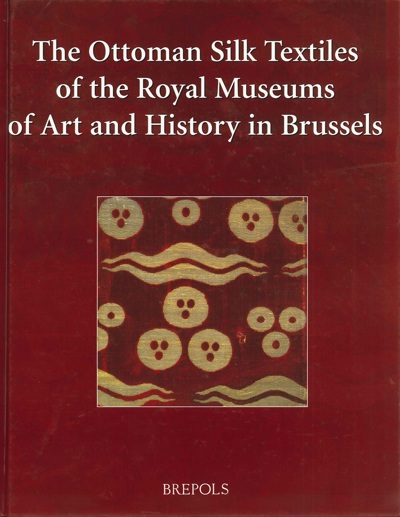
The Ottoman Silk Textiles of the Royal Museum of Art and History in Brussels
View publication
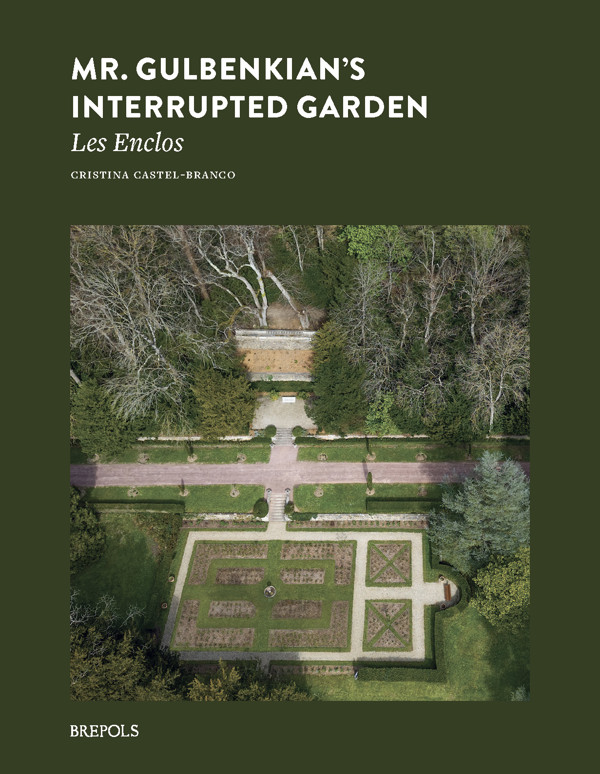
This book puts forward new information sourced on the areas of gardens and horticulture, from hundreds of letters, reports and original processes archived around the theme of Les Enclos, the property Calouste Gulbenkian acquired in Normandy towards the end of his life.
Cristina Castel-Branco is an international landscape architect, who received several awards including Premio Internazionale di Architettura Andrea Palladio 1988, the Merit Award by Boston Society of Landscape Architects to Boston Common Management Plan, with Victor Walker, 1993, the Prize of the European Commission for the Safeguarding of the Cultural Heritage of Europe, 1994, the Grandi Giardini d’Italia Prize, Milano, 1997 for the restoration of the Ajuda Botanical Garden, and several awards in her country. She is a garden historian, graduated in Landscape Architecture from the University of Lisbon, and completed her training at the University of Massachusetts in USA and at Harvard. She is a Full Professor, teaching since 1989 at the University of Lisbon, and directed the MLA and a Doctorate program in landscape architecture and urban ecology. In 1991, she founded the ACB-Landscape Architecture agency: she created and restored nearly 150 parks and gardens, founded the Portuguese Association of Historic Gardens and published 20 books, several scientific articles, and has spoken at more than 100 conferences.
Cristina Castel-Branco is a member of the International Scientific Committee for Cultural Landscapes of ICOMOS, UNESCO and is Vice President of the European Institute of Gardens & Landscapes. Her links with France and Japan are close: she translated into Portuguese the biography of Le Nôtre, Portrait of a Happy Man, by Erik Orsenna and received from the French Government the insignia of Chevalier (2005) et Officer (2013) of Arts and Letters. For her commitment with the Japanese_Portuguese long lasting history Japan awarded her the Medal of Honor and Merit in 2020 and the Order of the Rising Sun Award in 2026.
This book tells a story focused on an individual who played a very significant role in the making of this world from LES ENCLOS the late nineteenth century until the mid-twentieth century. In 1891, while still young, he published an article in one of the world’s most famous journals entitled ‘Petroleum: the new source of energy’, a somewhat obvious claim now but groundbreaking back then.
He structured his entire professional life around the defining of petroleum production and distribution strategies, negotiating and building physical, contractual, and financial structures that ensured petroleum would be transformed into the energy source that revolutionised the twentieth century. His success turned him into the richest man in the world of his time; he was referred to as ‘Mr 5%’, the percentage of profit he took from the consortium he organised to bring together the then four largest oil companies to exploit oil in the former Turkish empire.
Calouste Gulbenkian (1869-1955) was a collector of the artistic masterpieces and also had a passion for gardens. Whenever he travelled, he kept a diary in which he recorded the landscapes through which he passed, making personal comments about the quality of each place and noting his impressions of the gardens he visited. He also had a leather notebook with alphabetical, handwritten entries of his favourite gardens.
At the age of sixty-nine, Gulbenkian purchased and merged various plots of land in order to make a ‘garden in my own manner’, as he later explained, on a promontory near Deauville with a view of the sea and with a south-facing slope. Work then began at Les Enclos. However, military operations during World War II devasted the site after 1941 and halted Gulbenkian’s planting of his garden.
In 1942, Calouste Gulbenkian moved to Lisbon, where he would live until his death. He maintained a regular correspondence with Saint-John Perse, a future Nobel Prize winner, eventually exchanging a total of eighty-nine letters. The pair shared their views regarding their dream of a beautiful garden in Normandy. Gulbenkian also weekly wrote to and received reports from his gardener, Garbis Selian, who kept him updated about everything that was happening in Les Enclos and always paid and supported a team that strove to counter the effects of the war. Few gardens are as well documented as Les Enclos. The sources gathered in the Gulbenkian Foundation archives enable us to craft a more complete portrait of Calouste Gulbenkian than the biographies have hitherto shown us. He was a sensitive man who enjoyed views of the sea, who protected those whom he cherished and who worked for him. He was also passionate about botany and birds and grasped the miracles of Nature and the artistic effusion triggered by its blooming beauty, very often connecting art to nature. Through so many archival documents, glimpses of a love story whose secret was very well kept emerge, but, in the midst of the letters dictated by Mr Gulbenkian and the places visited, this story emerges alongside their shared passion for gardens.
Acknowledgements
António Feijó
Preface
Chapter 1 — Introduction
Just like spinning woollen yarn. One hand pulling the yarn forward, while the other pulls it backward.
Chapter 2
The leather notebook. Romancing a garden ‘à ma façon’.
Chapter 3
Les Enclos. A garden during the war. Nature comes back.
Illustrations
Chapter 4
The garden that was never built. A garden dreamed of by Saint-John Perse (Douglas) and Calouste Gulbenkian (Douglas).
Chapter 5
The carbon paper. … and the invisible Mme Theis.
Chapter 6
Madame Real. The Villa Sassetti garden in Sintra.
Chapter 7
Every cloud has a silver lining. The Calouste Gulbenkian garden in Lisbon, 1969.
Illustrations
Chronology of Gulbenkian’s life
Bibliography
Appendix 1 — List of catalogues of plants and garden materials belonging to Calouste Gulbenkian
Appendix 2 — List of garden books belonging to Calouste Gulbenkian
List of Illustrations
Postface