The Early Christian Monuments of Ravenna
DISCOUNT PRICE
View publication
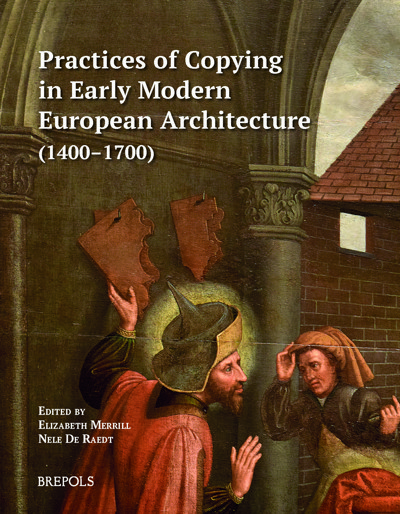
By focusing on practices of copying at the writing table, in the workshop and on the building site, this book opens up new ways to understand how architecture was theorized, studied, conceived and built in the early modern period.
Elizabeth Merrill specialises in early modern Italian architecture, with a research focus on architectural practices, and the means by which architects communicated building designs. She is Associate Professor of History and Theory of Architecture at Ghent University and the Principal Investigator of the ERC project “Copying as Common Practice in Early Modern European Architecture” (2023–2028).
Nele De Raedt specialises in architectural history and theory of the late mediaeval and early modern period, with a specific focus on the ethical and political questions related to architectural patronage and design. She is Associate Professor of Theory, History and Criticism of Architecture at UCLouvain.
This book explores copying in early modern European architecture with a specific focus on documented processes that took place at different instances in the theorisation, study, design and construction of architecture. The nine essays are deliberately diverse, spanning from fifteenth-century Italy to eighteenth-century England, from a humanistic tract dedicated to a Spanish noblewoman, to terracotta models for Milanese palace façades. But the contributions are united in their focus on the copy, and more fundamentally, in their common understanding of architecture as an iterative process, the contours of which extend far beyond the building site. In this framework, the authority granted to the architect is mitigated by the recognised involvement of a broad cast of characters: patrons, publishers, designers, craftsmen, workshop assistants and labourers. The studies assembled here elevate the copy from something secondary, derivative to an unrivalled tool for understanding the complex and often uncodified systems by which early modern architecture was realized. The copy is examined as an index of architectural practice, of techniques and activities that were often routine and direct, driven by needs of economy, efficiency, and scale. The very survival of the copy (and often of copies), confirms the heterogeneous and collaborative nature of the period’s architecture. Rarely, if ever, did building design begin from the metaphorical blank slate. Rather, as this book demonstrates, early modern architecture flourished thanks to the ties forged by direct copying and replication.
Elizabeth Merrill and Nele De Raedt
Introduction. From Imitating to Copying: The Practices of Writing, Drawing and Making Architecture
Peter Heinrich Jahn
Replicating, Sharing, Training: The Manual Copying of Plans in Architectural Practice and Apprenticeship within Late Roman Baroque and Related Central European Milieus
Elizabeth Merrill
Architectural Tracings and the Fragility of Design Authorship
Dario Donetti
Critical Copies: Architectural Exchanges in Raphael’s Rome
Martijn Van Beek
Copying for Contemplation and Persuasion: The Theological Appropriation of Vignola’s Regola in Juan Ricci de Guevara’s Imagen de Dios i de sus obras (Pintura sabia), 1662
Nele De Raedt
Rewriting One’s Own Work: Platina’s Ideal Residence for a Prince and Citizen
Gregorio Astengo
Property Development and Print Culture in Seventeenth-Century London: Genealogies and Networks
Merlijn Hurx
“Ikea-Architecture” in the Middle Ages: The Emergence of a Commodity Market for Building Components in the Low Countries
Jessica Gritti
Terracotta Architectures. Serial Production and the Diffusion of all’antica Models in Fifteenth-Century Lombard Architecture
Mark Wilson Jones
Changing Attitudes to Precedent from Emulation and Replication: Factors of Recognition and ‘Remove’