Transitions
View publication
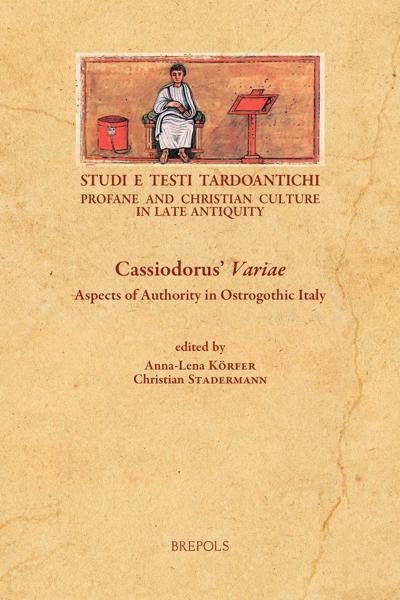
An exploration of the strategies behind the construction of authority in Ostrogothic Italy
Dr. Anna-Lena Körfer holds a position as Research Associate at the Herder Institute for Historical Research on East Central Europe in Marburg and is the coordinator of the Task Area “Data quality” in the consortium NFDI4Memory of the National Research Data Infrastructure (NFDI e.V.). Before, she was working in the project Humanist Computer Interaction under Scrutiny (Johannes Gutenberg university, Mainz), which focused on the detection of innovation capacities in using digital tools and methods in the Humanities. From 2008 to 2013 she was trained in History and Latin Language at the Justus Liebig university in Giessen, where she did her PhD in Latin Literature Studies on the Late Antique visual poetry of Optatian Porphyri (book published in 2020 under the title Kaiser Konstantin als Leser. Panegyrik, performance and Poetologie in den carmina Optatians). Her research interests include late antique literature (especially late antique poetry and panegyrics), Cassiodorus’ Variae, Digital Humanities, Digital Editions, and Research Data Management in the Humanities.
Dr. Christian Stadermann studied Medieval History at the universities of Göttingen, Nancy, and Heidelberg. He was Assistant Director of the Writing Center at the University of Tübingen, as well as a Research Assistant at the universities of Tübingen, Mainz, and Dresden. Currently, he teaches Late Antique and Early Medieval History (400-1000) at Greifswald University and is working on a research project on the reception of Late Antique History in the High Middle Ages. He has published his dissertation and several articles on Merovingian and Gothic history. His research interests include the history of Merovingian Gaul, Visigothic Spain, Cassiodorus and Ostrogothic Italy, as well as Late Antique and Medieval historiography and hagiography.
In sixth-century Ostrogothic Italy, social coexistence was largely based on permanent negotiation processes of authority (auctoritas), which can be explored through the lens of Cassiodorus’ letters (Variae). The contributions collected in this volume seek to explore the mechanisms by which different actors in Ostrogothic Italy constructed authority.
Introduction: Approaches to Authority in Ostrogothic Italy (Anna-Lena Körfer & Christian Stadermann)
The Dynastic Tradition of the Amals: A Deliberate Construction? (Robert Kasperski)
Cassiodorus the Historian and the Construction of auctoritas in the Italy of the Amals (Massimiliano Vitiello)
Impressionner et se distinguer. La table royale des souverains ostrogothiques et la pourpre (Valérie Fauvinet-Ranson)
Remembering Theoderic the Great: Making Tradition and Construction of Authority at the Court of King Athalaric (526-534) (Christian Stadermann)
Loans of Light and Ostrogothic Helmets: Communicating Authority during the Reign of Theodahad (Marco Cristini)
In Search of Consensual Taxation: Ideology and Practice of Fiscality in Cassiodorus’ Variae (Giovanni A. Cecconi)
Portare principis imaginem. Authority and Ideology in Cassiodorus’s Conceptualization of the Quaestorship (formula quaesturae) (Tabea L. Meurer)
Between Christian Condemnation and Cultural Prestige. The Representation of the spectacula in Cassiodorus’ Variae (Konrad Löbcke)
Index
The Authors