Alfonsine Astronomy: Expanding the Scenes
View publication
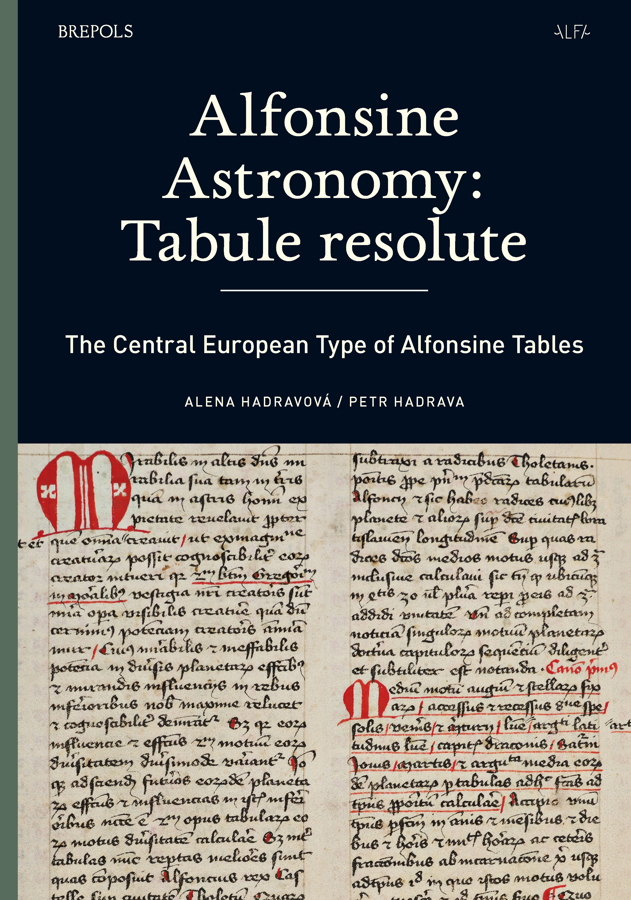
This monograph presents a Latin edition and English commented translation of the Tabule resolute, a medieval set of Alfonsine astronomical tables and rules (canons) for calculation of the planetary motions, widespread in Central Europe in the 15th and 16th centuries.
Alena Hadravová is a classical philologist and a medievalist at the Institute of Contemporary History, Czech Academy of Sciences.
Petr Hadrava is an astrophysicist at the Astronomical Institute, Czech Academy of Sciences.
Together they have published a number of papers and monographs on the history of astronomy.
Astronomers and astrologers in medieval Europe used sets of numerical tables, accompanied by detailed instructions for use, to calculate the motions of the planets. The Castilian Alfonsine Tables, created at the court of Alfonso X in Toledo after the middle of the thirteenth century, form the basis of the Latin Parisian Alfonsine Tables (1320s) which became the starting point for the further dissemination and elaboration of astronomical tables in European universities and other cultural centres between the fourteenth and first half of the sixteenth century.
A central European version of the Alfonsine Tables are the so-called Tabule resolute. This version was initially compiled for the meridian of Wrocław in 1424 and later recalculated for the meridians of Prague, Cracow, Leipzig, Salamanca, Bologna and other cities. The Tabule resolute are preserved in dozens of manuscripts and in several early modern prints, containing both the tables and the rules (‘canons’) for them. This volume presents the first edition of both the Wrocław tables and variants for other meridians and selected canons for their use, compiled by Petrus Cruciferus, Nicolaus Wodka and John of Głogów. The Latin editions are accompanied by annotated English translations. The work is concluded with an explanation of the mathematical principles of the tables and an analysis of the errors in the edited tables.
Acknowledgements
1. Introduction
I. CANONS
2. Canons Mirabilis in altis Dominus by Petrus Cruciferus
3. Canons Girum recensendo by Andrzej Grzymała of Poznań
4. Canons Nemo integre sapit by an anonymous author
5. Canons Astrorum (observatores) sapientes by Albertus of Brudzewo
6. Canons Quoniam Tabularum Alfonsi by Nicolaus of Tuchów (Polonus)
7. Canons Quoniam plerique nostri temporis phisici by Nicolaus Wodka of Kwidzyn
8. Canons Pro (introduccione) generali by John of Głogów
9. Early modern prints with canons to the Tabule resolute
10. Overview of the rules in the canons to the Tabule resolute
II. TABLES
11. List of manuscripts with the Tabule resolute
12. Tabule resolute for the meridian of Wrocław
13. Tabule resolute for the meridian of Prague
14. Tabule resolute for the meridian of Cracow
15. Peculiar sets of the Tabule resolute
16. Additional tables
17. Overview of tables in the Tabule resolute
III. COMMENTARY
18. Mean motions
19. Apogees of planets
20. Mean conjunctions and oppositions of the Sun and Moon
21. Equation of the Sun
22. Equations of the Moon
23. Equations of planets
24. Retrogradation
25. Equation of time and right ascension
26. Oblique ascensions and visibility of planets
27. Interpolation
- Editorial note, Abbreviations
- Bibliography (List of manuscripts, Early modern printed sources, Literature)
- Index of names, Glossary of chosen Latin terms