Faith and Knowledge in Late Medieval and Early Modern Scandinavia
View publication
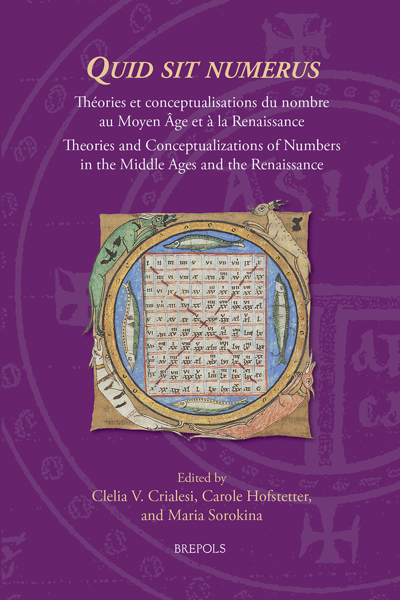
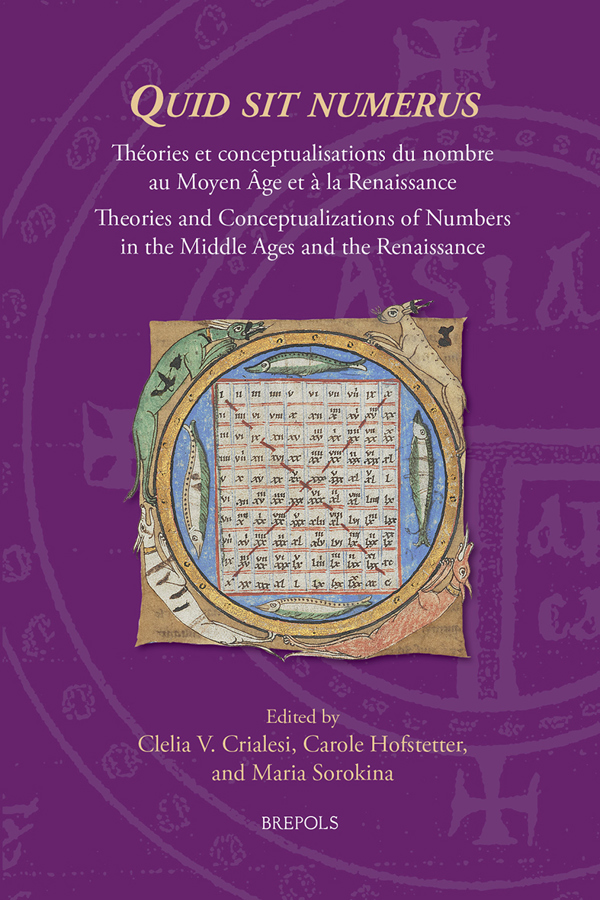
The book offers an in-depth analysis of the role played by numbers in the human understanding of the universe and their impact on various disciplines.
Clelia Crialesi is a Marie Skłodowska-Curie Fellow at SPHERE-CNRS (Paris, France). Formerly, she was an FWO Research Fellow at KU Leuven (Belgium) and a Mellon Fellow at PIMS (Canada). Her research focuses on premodern mathematical thought, with publications ranging from Boethian number theory to Euclidean geometry in the late medieval continuum debate and epistemology of 14th-century algebraic practices.
Carole Hofstetter is an ANR Research Fellow at the SPHERE laboratory (CNRS) and a Research Associate at the SAPRAT laboratory (EPHE-PSL). Her work focuses on the history of texts and Greek palaeography and codicology. She is leading a research project on Neoplatonic mathematical knowledge and is preparing a critical edition of Nicomachus of Gerasa's "Introduction to Arithmetic".
Maria Sorokina is a Research Fellow at the CNRS (Paris). She is a scholar of medieval history of science, specializing in the history of astrology and cosmology. Her research interests include the ontology of numbers. She has published several articles on the medieval discussion on this issue (mainly, in the commentaries on the Sentences).
Numbers have long occupied a fundamental place in human thought, a fact made especially clear in the writings of Latin premodern thinkers. Their fascination echoes through the repeated citation of Wisdom 11,21: But you have disposed all things by measure and number and weight. From the philosophical reflections of Nicomachus of Gerasa and Boethius to the intricate interpretations of John Dee, conceptions of number shaped how scholars perceived the world, time, and the very essence of things. This volume traces the significance and evolution of these multifaceted conceptions across disciplines, from the Middle Ages to the Renaissance. It also investigates the diverse meanings and uses of numbers—their ontological nature, epistemic value, their supposed role in shaping the universe, and their wide array of symbolic applications. What is a number? How do humans come to know it? What role does it play in structuring reality? And how do we use it to count and order the things around us? Together, the contributions aim to disentangle the distinctive premodern perspective on this enduring set of questions.
List of Figures
Acknowledgements
Introduction
Section I – Understanding Numbers in Mathematics
Numbers in Medieval Speculative Arithmetic: Boethius and his Readers
Clelia V. Crialesi
Nombre du philosophe, nombre du mathématicien
Sabine Rommevaux-Tani
L’identification des nombres premiers entre eux: une question de méthode ou un problème textuel?
Carole Hofstetter
Section II – Grasping Numbers in Philosophy
The Form of Number and his Critics
Kamil Majcherek
Indépendants de l’intellect et perçus par les sens: un argument dans la discussion sur l’ontologie des nombres (XIIIe-XIVe siècle)
Maria Sorokina
Les ‘nombres formels’ au Moyen Âge et à la Renaissance
Jean-Marc Mandosio
Section III – Employing Numbers in Exegesis
Les nombres dans l’exégèse médiévale de la Bible
Gilbert Dahan
Le nombre dans les commentaires latins de l’Apocalypse au haut Moyen Âge
Gaelle Bosseman
Section IV – Unveiling Numbers in Reality
Pythagore et la divination par les nombres. Les sphères de vie et de mort dans la tradition latine
David Juste
Cosmopoeia Timaei according to Gerbert of Aurillac and Adalbold of Utrecht
Marek Otisk
À la recherche du ‘numerus chaldaeus’ dans l’astronomie et le comput du Liber Nemroth
Isabelle Draelants
Index of Names