Agricultural specialisation and rural patterns of development
View publication
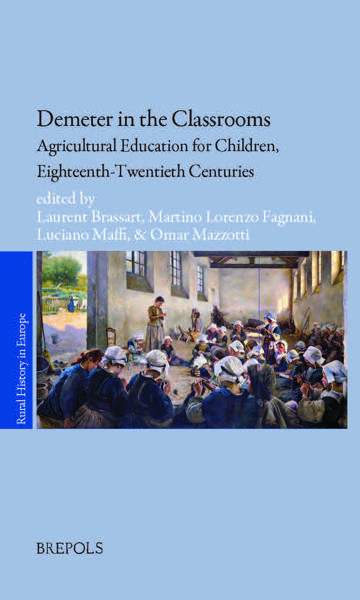
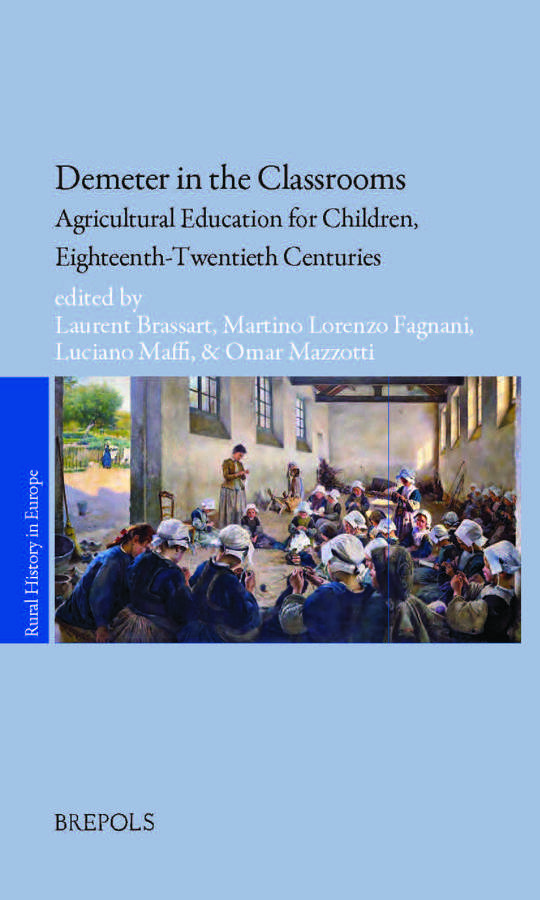
In this groundbreaking book, scholars from different countries discuss children's agricultural education by considering its many components and aspects: educational programs, teachers' training, textbooks, practical activities, teaching gardens, small mineralogical, botanical and zoological collections, and the institutional aspect.
Laurent Brassart is Associate Professor in Early Modern History at the University of Lille, France and member of HARTIS UMR CNRS 9028 research center. His main research interests deal with the history of the State and political regulations in the European countryside, the construction of agricultural knowledge, their circulation and translation into ublic policy.
Martino Lorenzo Fagnani is a Postdoctoral Fellow at the University of Pavia, Italy. His main research interests are the history of agricultural science, environmental history, the history of travel, and food history through the early modern period and part of the nineteenth century.
Luciano Maffi is Associate Professor in Economic and Global History at the University of Parma, Italy. He also teaches Economic History at the Catholic University of the Sacred Heart in Milan, Italy. His main research interest is the rural sector and food production in Early Modern and Modern history.
Omar Mazzotti is Researcher at the University of Parma, Department of Economics and Management, with a project on Made in Italy. He also teaches Economic History at the University of Bologna, at the Forlì Campus. His main research interest is the history of agriculture, with particular reference to the agricultural education, and the history of welfare and the voluntary sector in the modern and contemporary eras.
Agricultural education for children has played a key role in shaping the younger generation, connecting school, agriculture and nature. This volume explores the topic at the European level, analysing the role of institutions, state policies and pedagogical models in modelling the teaching of agriculture to children from the eighteenth to the twentieth centuries. Through an interdisciplinary approach that weaves together the history of education, rural history and the history of science, the authors display how the teaching of agricultural practices contributed to the economic and social development of different European realities. The book brings together contributions spanning from France to Italy, from the United Kingdom to Spain, from Sweden to Hungary and Romania, among other cases, providing a comparative picture of the different national experiences. The pages address crucial issues such as the training of primary school teachers, the use of school gardens, the transmission of agricultural knowledge in textbooks, the circulation of pedagogical ideas and models of teaching spaces. The studies gathered in this volume are essential for understanding the evolution of socio-environmental relationships in Europe from childhood and early youth, crucial moments in the formation of the individual.
1. From field to classroom and back. Policies, practice, and knowledge transmission
Laurent Brassart, Martino Lorenzo Fagnani, Luciano Maffi and Omar Mazzotti
Part 1 - Agriculture, education, and the state
2. Teaching agriculture to French children and teenagers. The longterm political realization of an old educational project (1760-1940)
Laurent Brassart
3. “Back to the Fields!”. Elementary agricultural teaching in Italy between the late nineteenth century and fascism
Erminia Irace and Manuel Vaquero Piñeiro
4. Hope and fear in post-war Romania. Emotions, politics, and agricultural education (1919-1929)
Ionela Zaharia-Schintler
Part 2 - Circulating ideas
5. Women and the “new agriculture”. Imaginaries, discourses and possibilities in Enlightened Spain
Elena Serrano
6. Agricultural education for children and the circulation of models. From central Europe and France to southern Europe, eighteenth and early nineteenth centuries
Martino Lorenzo Fagnani
7. Farming futures. Building agricultural education in Britain in the long nineteenth-century
Steven King
8. “Fra i campagnuoli” [Among the peasants]. Italian textbooks for rural schools (1861-1929)
Elisa Marazzi
Part 3 - Teaching to the teachers
9. Agricultural education in primary schools in Sweden c. 1850-1919. Central directives and local implementations
Sofia Carlfjord and Patrick Svensson
10. Elementary teachers and the modernisation of beekeeping in Hungary in the late nineteenth century
Attila Nóbik
11. Agricultural education in Italian primary school public policies (1861-1900)
Omar Mazzotti and Luciano Maffi