Les formes laïques de la philosophie
View publication
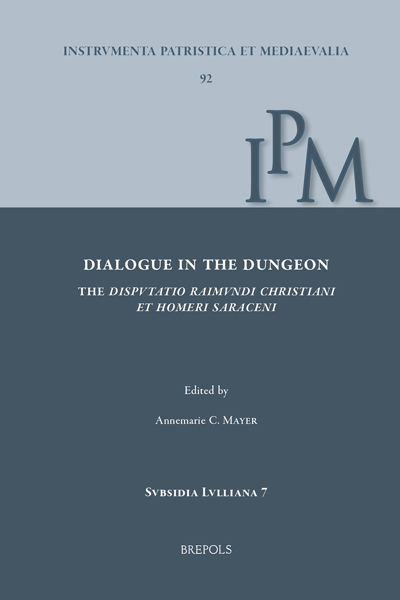
The somewhat unequal debate of Raymond, the imprisoned Christian, and ‘Umar, the Muslim scholar, read and interpreted in the context of Llull’s work and time.
Annemarie C. Mayer is a systematic theologian with a vivid interest in the doctrine of God and, in particular, controversial theology, polemics, and inter-religious encounter in the œuvre of Ramon Llull. She investigates Llull’s writings in order to better understand the intricacies of the relations between Christianity, Judaism, and Islam on the Iberian Peninsula at his time and thus to provide a ‘pre-history’ of modern interreligious dialogue.
Religions are not only cultural artefacts. Their peaceful coexistence cannot be secured simply by ignoring the doctrines that divide – and define – them. Throughout the ages, the proponents of divergent religious views did argue about differences. The 'Disputatio Raimundi christiani et Homeri saraceni' is in the focus of this volume: the Christian Ramon’s dispute with the Muslim Homer (‘Umar), held in 1307 and written down in 1308, provides an ideal example for a case study of medieval Christian-Muslim dialogue, despite the fact that the conditions were somewhat unequal, the Christian being in jail and the Muslim scholar sent to convert him. Although the purpose on both sides was mission through dialogue and not dialogue as such, the Disputatio Raimundi proves Ramon Llull (1232-1316) to have been an extraordinary medieval intellectual and a precursor of interreligious dialogue in the modern sense. This volume discusses the important aspect of disputing with Islam in the life and work of Ramon Llull as well as in 13th century Christian-Muslim relations in general. For the latter the Disputatio Raimundi serves as a test case and thematic guideline. The volume develops a framework for the study of this work of Ramon Llull’s and connects it with the wider medieval debate on Christian-Muslim relations.
Herman Teule (Faculteit theologie en religiewetenschappen, KU Leuven)
Christianity in the Middle East in the Times of Ramon Llull
Lola Badia (Centre de documentació Ramon Llull, Universitat de Barcelona)
Staging Persuasion and Dissent in Ramon Llull’s Narrative Dialogues
Margot Leblanc (KU Leuven)
God’s power in the works of Ramon Llull
Simone Sari (Centre de documentació Ramon Llull, Universitat de Barcelona)
«Saracenus non considerat nomen Dei ita altum, sicut christianus»: God’s essential attributes in Christianity and Islam according to Llull
Hans Daiber (Goethe Universität Frankfurt a.M.)
The Disputatio Raimundi Christiani et Homeri Saraceni in the Light of Muslim Thought
Ryan Szpiech (Department of Romance Languages and Literatures; Frankel Center for Judaic Studies, University of Michigan, Ann Arbor)
Reading the Disputatio Raimundi christiani et Homeri saraceni in light of the Thirteenth-Century Debate over Authority
Robin Vose (History Department, Saint Thomas University, Fredericton)
Preachers, Teachers, and Fools: Dominican influence in Ramon Llull’s dialogue with Islam
Emilio Platti OP (Interdisciplinair Centrum voor Religiestudie en Interlevensbeschouwelijke Dialoog, KU Leuven)
An Assessment of Lull’s Interreligious Endeavours from a Contemporary Perspective
Eleanor Goerss (Harvard University)
Out of the Dungeon: Rewriting Lullian Dialogue in Fourteenth-century France