Lambèse chrétienne
View publication
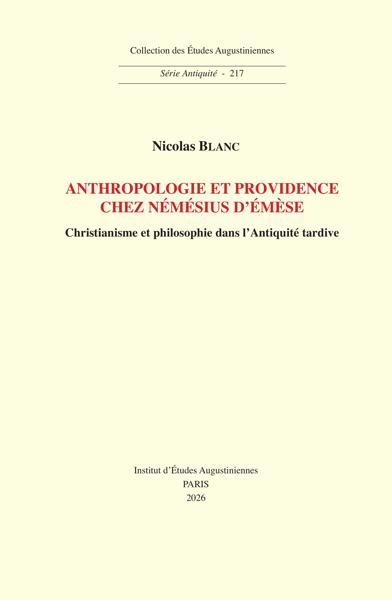
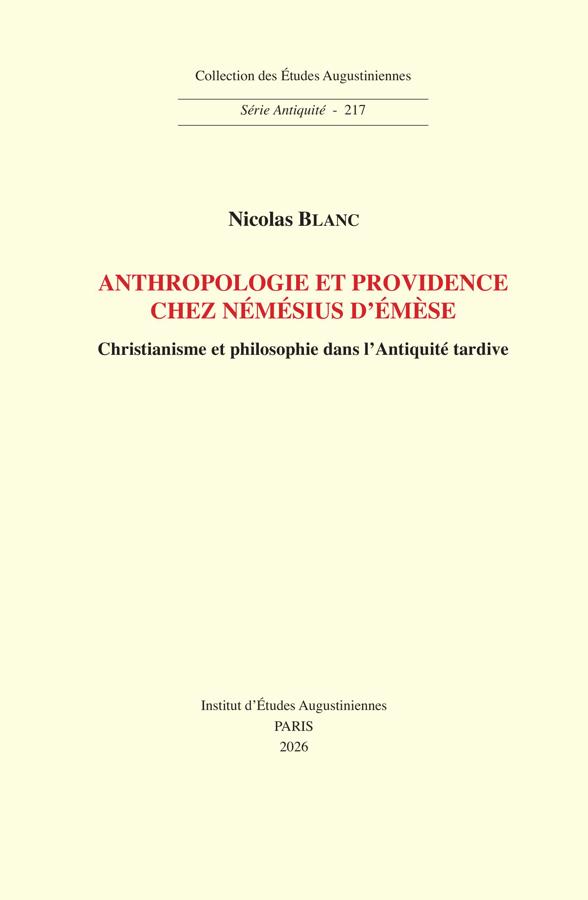
The De natura hominis of Nemesius, bishop of Emesa in Syria in Late Antiquity, has been studied above all for its sources (Philopator, Ammonius/Porphyry), its influence (Maximus the Confessor, John Damascene, Thomas Aquinas, etc.), or its anthropology. This apologetic treatise, however, contains unprecedented developments in ancient Christian literature on fate, self-determination and providence. This study aims to shed light on this important contribution, showing how the author redeployed certain conceptual and problematic networks of Greek philosophy in order to translate the specificities of the Christian conception of providence. His argument in favor of unconditioned divine sovereignty, of the immediacy of providence and of the existence of a special providence for man, marks a historical knot which fully inscribes this work in the genealogy of the notions of omnipotence and divine permission, and in the philosophical emergence of the subject and the free will.
Le De natura hominis de Némésius, évêque d’Émèse en Syrie dans l’Antiquité tardive, a surtout été étudié pour ses sources (Philopator, Ammonius/Porphyre), son influence (Maxime le Confesseur, Jean Damascène, Thomas d’Aquin, etc.) ou son anthropologie. Ce traité apologétique contient cependant des développements sans précédent dans la littérature chrétienne antique sur le destin, l’autodétermination et la providence. Cette étude vise à mettre en lumière cette importante contribution, en montrant comment l’auteur a redéployé certains réseaux conceptuels et problématiques de la philosophie grecque afin de traduire les spécificités de la conception chrétienne de la providence. Son argumentation en faveur de souveraineté divine inconditionnée, de l’immédiation de la providence et de l’existence d’une providence spéciale pour l’homme, marque un nœud historique qui inscrit pleinement cette œuvre dans la généalogie des notions de toute-puissance et de permission divine, et dans l’émergence philosophique du sujet et du libre-arbitre.
Avant-propos
Abréviations
Introduction
Première partie. Unité, structure et finalité du De natura hominis
Chapitre premier. L’auteur et l’œuvre
Chapitre II. La date du De natura hominis
Chapitre III. La tradition doxographique
Chapitre IV. La tradition médicale
Chapitre V. La tradition philosophique
Chapitre VI. La tradition apologétique
Deuxième partie. Place et vocation de l’homme dans la création
Chapitre premier. La perfection de l’homme corps et âme intellective
Chapitre II. Les œuvres de la sagesse du Créateur
Chapitre III. Les origines et la catastase de la vie présente
Chapitre IV. Panégyrique final
Troisième partie. Le destin, l’autodétermination, la providence
Chapitre premier. Le destin
Chapitre II. L’autodétermination ou ce qui dépend de nous
Chapitre III. La providence
Conclusion
Annexe (traduction DNH chapitres : 1 ; 3 ; 35 à 43)
Bibliographie
Index des auteurs anciens