Thinking Through Excerpts
View publication
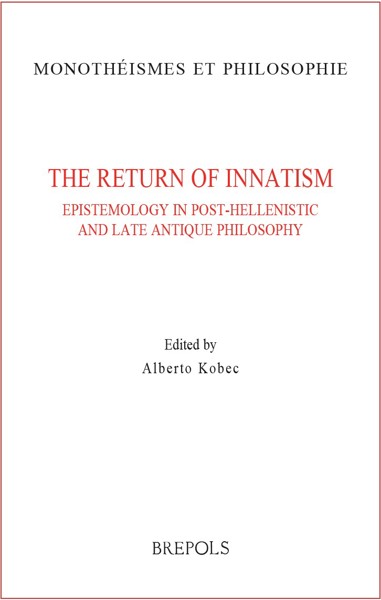
This volume explores epistemological issues and debates in post-Hellenistic and late antique philosophy.
Alberto Kobec is currently a voluntary research associate at the De Wulf-Mansion Centre for Ancient, Medieval and Renaissance Philosophy at KU Leuven, where he obtained his PhD in 2020. His research centers on issues related to Neoplatonic logic, metaphysics, and philosophy of nature, with a special focus on the reception of Aristotle’s doctrine of categories in late antiquity.
This volume investigates the development of epistemological debates in post-Hellenistic and late antique philosophy, with particular attention to the enduring influence exerted by Hellenistic reflections on the nature of knowledge and the process of knowledge acquisition on later philosophical movements in the Greco-Roman tradition. Hellenistic thinkers placed the question of the possibility and foundation of knowledge at the forefront of philosophical inquiry, developing sophisticated theories to describe how it is possible to attain knowledge and to neutralize sceptical threats starting from a secure empirical basis able to provide infallible criteria of truth.
The aim of the volume is to shed new light on the elements of continuity and influence—and not only of transformation or rupture—between the rich epistemological discussions of the Hellenistic era and later theorizing about knowledge and associated forms of cognition, both within the same schools of thought and across rival schools.
The progressive reappearance of anti-empirical, rationalist theories of knowledge and the dominance acquired by dogmatic Platonism over competing philosophical movements led to the return of innatism and of the doctrine of recollection of inborn, latent cognitive contents as the prevailing epistemological framework in late antiquity. Yet, as the studies collected here show, this prevalent trend does not entail a simple rejection or neglect of the Hellenistic heritage, but rather a critical confrontation and, at times, a polemical appropriation of some central epistemological tenets developed by the Hellenistic schools.
Acknowledgements
Epistemological Trends in Post-Hellenistic and Late Antique Philosophy. An Introductory Overview
Alberto Kobec
Part I. Post-Hellenistic Epistemological Debates in Non-Platonist Authors
Chapter 1. Proof as a Criterion of Truth. Andronicus and Boethus on Articulating Preconceptions
Michael J. Griffin
Chapter 2. Au point de rencontre du stoïcisme et du platonisme. Note sur le concept d’αἴσθησις chez Philon d’Alexandrie
Carlos Lévy
Chapter 3. Epictetus’ Practical Strategy Against Scepticism and the Early Imperial Philosophical Scene (Plutarch, Favorinus, Galen)
Thomas Bénatouïl
Chapter 4. Epistémologie et critère chez Galien
Jean-Baptiste Gourinat
Part II. Epistemological Themes in the Platonic Tradition of the Early Empire and Late Antiquity
Chapter 5. Anon. in Theaetetum and Innatist Uses of Arcesilaus’ Heritage
Harold Tarrant
Chapter 6. Logos and logoi as Criteria in Proclus
Pieter d’Hoine
Chapter 7. La connaissance chez Damascius. Quelques considérations
Marc-Antoine Gavray
Bibliographie
Index Locorum
Index of Ancient Names
Index of Modern Authors