New Avenues in Biblical Exegesis in Light of the Septuagint
View publication
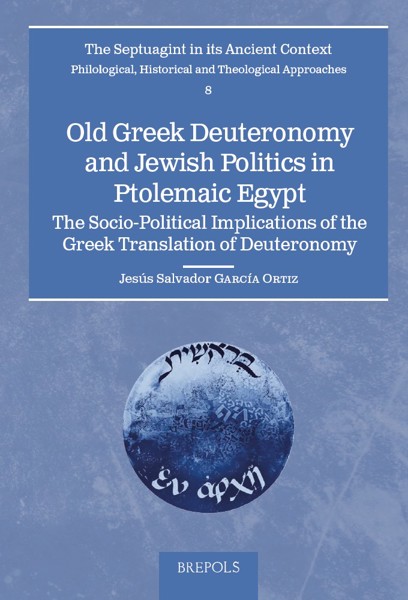
The proclamation of the Second Law in Ptolemaic Egypt and its implications
Jesús Salvador García Ortiz was born in Monterrey, Mexico, in 1983. He is a catholic diocesan priest incardinated to the Archdiocese of Monterrey since 2013. He obtained a bachelor’s degree in Sacred Scriptures from the Pontifical Biblical Institute in 2017. With the publication of this dissertation, he has obtained his doctorate in Sacred Scriptures from the same institution.
The Torah was the first block of the Jewish Sacred Scriptures translated into Greek in Egypt in the third century BCE. Among the five books, the Greek Deuteronomy predominantly shows consistency in word order, style, structure, and lexical and syntactic equivalence with the Hebrew text. There are even some Semiticisms. Therefore, there is formal equivalence between the Greek translation and its presumable Hebrew source text, both quantitatively and qualitatively. However, the Greek text occasionally varies from the expected Greek term for a specific Hebrew word. The lexicon relating to judicial, social, and political officials is a case in point, which is not always fixed. This study elucidates the rationales underlying the use of κριτής and γραμματοεισαγωγεύς in Deut 1:9-18; 16:18–17:13; ἄρχων in Deut 17:14-20; ἀρχίφυλος and γερουσία in Deut 29:9-14, and φύλαρχος, πρεσβύτερος and ἐκκλησία in Deut 31:24-30.
The aim of this research is to outline the socio-political context of the Greek translation of Deuteronomy in Ptolemaic Egypt. For this purpose, this study considers the pre-Hellenistic and Hellenistic use of the terms under scrutiny, the Egyptian Ptolemaic papyrological and epigraphical evidence of the time, the comparison and the exegetical analysis of the oldest available Hebrew text and the Old Greek text, and the discussion on the Hebrew Vorlage of the Old Greek text of those passages.
This study contributes to understanding the Jewish effort to strengthen Israelite political identity within a Greek milieu, as well as the socio-political discourses that preceded the creation of the Greek translation of Deuteronomy.
Introduction
Chapter I. The Jewish Judicial Notaries and Judges (Γραμματοεισαγωγεύς and Κριτής)
Chapter II. The Jewish Ruler and the Ptolemaic King (Ἄρχων and Βασιλεύς)
Chapter III. Tribal Leaders and Elders along with Judges and Judicial Notaries in the Assembly (Ἀρχίφυλος / Φύλαρχος – Γερουσία / Πρεσβύτερος – Ἐκκλησία)
General Conclusions
Abreviations
Bibliography