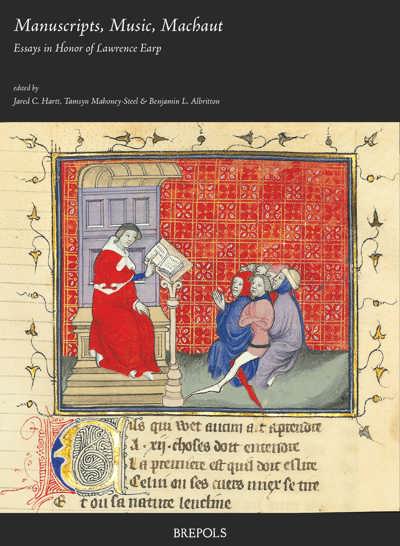
Manuscripts, Music, Machaut
View publication
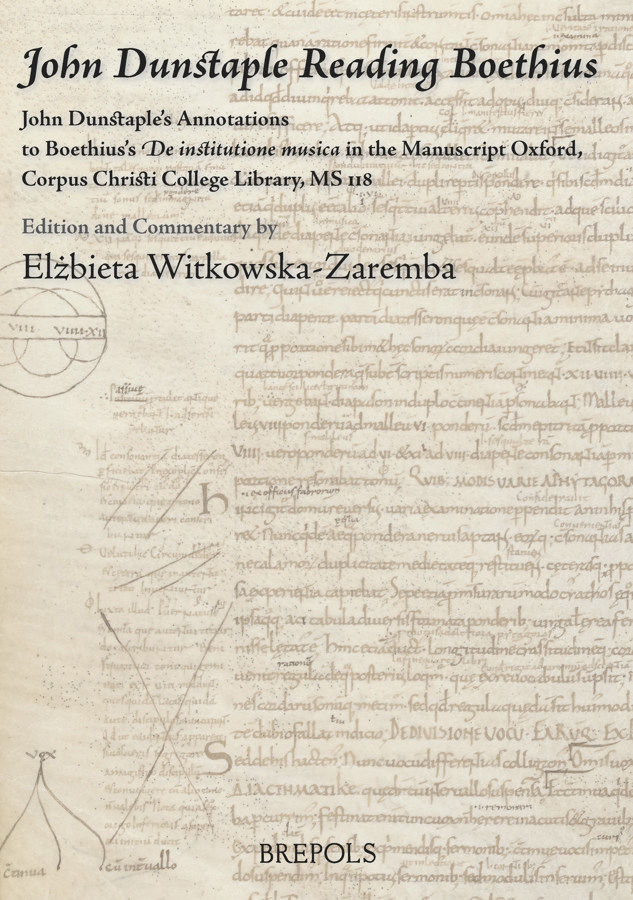
The edition introduces the reader in the world of music theory developed by Boethius, the most influential theorist of Latin Europe, as explained by John Dunstaple, the foremost English composer of the Late Middle Ages.
Elżbieta Witkowska-Zaremba is a professor at the Department of Musicology at the Polish Academy of Sciences Institute of Art. Her main area of research is history of music and music theory focused on Latin texts of the late Middle Ages and early modern era, and the reception of the ancient writings on music up to 1600. She published a number of critical editions of music treatises, among others treatises by Georgius Libanus, Sebastianus de Felstin, Martin Kromer, Musica speculativa by Johannes de Muris, two anonymous Prague organ treatises from the 15th century and two organ treatises by Joannes de Lublin. Together with Michael Bernhard she co-edited the multi-volume Traditio Iohannis Hollandrini, a collection of Central-European chant treatises from the fifteenth and sixteenth centuries. Her recent research focuses on English sources concerning music theory.
European theory of music up to ca.1550, in many respects, presents a history of the reception of Boethius’s treatise De institutione musica (before 510). The annotations introduced to this treatise by John Dunstaple (d. 1453), eminent composer of the late Middle Ages, add to our knowledge of the English chapter of this history.
The volume is composed of two parts. The first part includes the edition of Dunstaple’s annotations paralleled with relevant parts of Boethius text and provided with the introduction comprising a detailed information on manuscript Oxford, Corpus Christi College 118 and the study of Dunstaple’s hand. In the second part of the book, the selected glosses which have the strongest interpretive potential are translated and examined in a large context of music theory of Middle Ages. They present Dunstaple as a careful and competent reader of Boethius’s arguments and a composer well-read in music theory current in his time.
List of Figures
List of Tables
Preface and Acknowledgements
Introduction
(1) Dating, origin, and contents of the first part of Occ. 118
(2) Dunstaple’s hand
(3) Typology of Dunstaple’s annotations and editorial policy
Edition of Dunstaple’s annotations to Boethius’s De institutione musica in Occ.118
Liber I
Liber II
Liber III
Liber IV
Liber V
Commentary on the Selected Glosses, Additions and Diagrams
Chapter One. De musica, Book I
1) General remarks
2) ‘republica, liber quidam Platonis’
Republic, a certain book by Plato’. Mus. I, 1.
3) ‘Musica bene morata’
Music of good character. Mus. I, 1.
4) Decretum Lacedaemoniorum
Spartan Decree. Mus. I, 1.
5) Diagram of the fundamental consonances. Mus. I, 10.
6) Descriptions of the consonances. Mus. I, 15; Mus. I, 16.
7) The division of the diatessaron and the proportion of the minor semitone. Mus. I, 17.
8) The tone as the difference between the diatessaron and the diapente. Mus. I, 18.
9) The diapason consists of five tones and two semitones. Mus. I, 19.
10) ‘Those who make art should be named artifices’. Mus. I, 34.
Chapter Two. De musica, Books II and III
1) General remarks
2) The order and positions of the consonances. Mus. II, 19–20.
3) The division of the tone. Mus. III, 1.
4) Calculating the difference between five tones and the bis-diatessaron, and six tones and the diapason. Adding and subtracting musical intervals. Mus. III, 3–4; Mus. III, 9.
5) Dividing the tone according to Philolaos. Mus. III, 5.
6) ‘Unitas non est numerus’
Unity is not a number. Mus. III, 11.
Chapter Three. De musica, Books IV and V
1) General remarks
2) Calculating continuous sesquioctave ratios. Mus. IV, 2.
3) ‘Extenta, id est relaxata’
Extended means relaxed. Mus. IV, 3.
4) ‘Dicciones, id est nomina cordarum’
Words, that is, the names of strings. Mus. IV, 3.
5) Diagrams of the eight modes. Mus. IV, 15–17.
6) The division of the monochord. Mus. IV, 18.
7) The divisions of the genus diatonicum according to Martianus Capella. Mus. V, 18.
Conclusions
Bibliography
General Index
Permissions to reproduce