
Italian Opera and European Theatre, 1680-1720: Plots, Performers, Dramaturgies
View publication
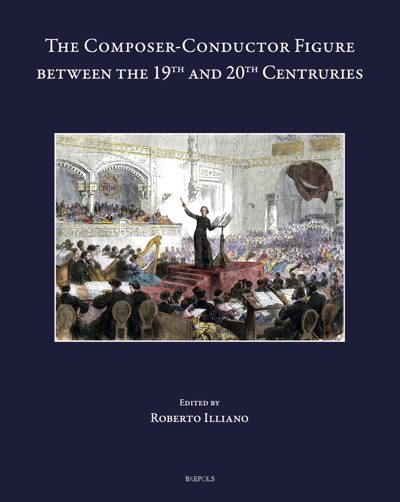
In this volume, twenty-four authors dedicate their chapters to the most important composer-conductors of the nineteenth and twentieth centuries.
Roberto Illiano is General Secretary of the Centro Studi Opera omnia Luigi Boccherini and President of the Italian National Edition of Muzio Clementi’s Complete Works. He is General Editor of the series ‘Speculum Musicae’ and ‘Staging and Dramaturgy: Opera and the Performing Arts’ (Brepols Publishers), and has published a variety of writing (edited volumes, articles, editions, and dictionaries entries) on 19th- and 20th-century music, in particular on Luigi Dallapiccola and Italian music under Italian fascism.
Between the nineteenth and twentieth centuries, many great musicians served as both composers and conductors, often conducting their own works or those of other composers. In the nineteenth century, it was common for a talented musician to be a skilled performer (often a pianist or violinist), composer and conductor. Notable figures such as Liszt, Wagner, Mahler and Strauss conducted their own works to promote them and ensure their artistic integrity. Conducting was seen as a natural extension of musical creation rather than a separate career. However, the role of the conductor-composer changed significantly between these two centuries, reflecting the increasing complexity of music, the expansion of the orchestra, and above all, the emergence of conducting as a highly specialised and autonomous profession. Furthermore, while composer-conductors often took great interpretative liberties in the nineteenth century, an ideal of fidelity to the score slowly developed in the twentieth century. This was partly because twentieth-century scores required a much higher level of rhythmic precision and clarity of execution, favouring the development of rigorous conducting techniques. In this volume, twenty-four authors dedicate their chapters to the most important composer-conductors of the nineteenth and twentieth centuries, addressing them from various perspectives, including gesture, orchestral repertoire, reception, legacy, reputation, press criticism and their role in promoting new music.
Roberto Illiano, Preface
Massimiliano Locanto, The Composer on the Podium: A Dual or a Multifaceted Figure?
Early Nineteenth-Century Composer-Conductors
Samuel T. Nemeth
Berlioz Conducting Berlioz’s Orchestra: Composer Stewardship, Sonic Control, and the ‘Monster Concerts’
Siegwart Reichwald
Building Community: Felix Mendelssohn, the Rise of the Modern Orchestra, and the Expanding Role of the Conductor
Jacques Dupuis
Robert Schumann’s Blithe Conducting? Self-Determination, Nationalism and Musical Work
Mid-Nineteenth-Century Perspectives
Donna M. Di Grazia
Franz Liszt as Conductor, as Interpreter: Perspectives on Sources and Scholarship
José Ignacio Suárez García
Wagner Conducts in Paris: A Reinterpretation of the Concerts at the Théâtre-Italien (1860)
Jacquelyn Sholes
Brahms as a Conductor: Fraternalism, Antiquarianism, and Other Points of Intersection with Brahms the Composer
Michael Stegemann
«An iron will, an invincible arm»: Camille Saint-Saëns as Conductor
Fin-de-siècle Composer-Conductors
James L. Zychowicz
Mahler at the Podium: The Composer-Conductor Reinvented for a New Century
Faith Thompson
Gabriel Pierné at the Concerts Colonne and Beyond
Vadym Rakochi
Seeing the Invisible: Strauss the Composer – Strauss the Conductor
Vera Val’kova
Sergey Rachmaninoff the Conductor: The Paradoxes of an Artistic Career
Twentieth-Century Composer-Conductors
Alison Sanders McFarland
Racing through London and Mars: Holst the Pedagogue and Conductor
Renata Suchowiejko
A Life in Music through Turbulent Times: The Conducting Career of Grzegorz Fitelberg (1879-1953)
Mila De Santis
Alfredo Casella: Conductor between Two Worlds
Barbara L. Kelly
Performing Internationalism: Eugene Goossens’s Advocacy for New Music
Carol A. Hess
«I Started Late; It’s a Passion Now»: Aaron Copland’s Conducting Career
Kevin Salfen
Lessons from the Podium: Britten’s Conducting Education
Paul R. Laird
Composing vs Conducting: Leonard Bernstein’s Lifelong Struggle
Levon Hakobian
Gunther Schuller, a «Compleat» Musician
Chloë Rouge
Presences and Absences. Pierre Boulez’s Schedules: Towards an Analysis of Pluri-Activity
Abstracts and Biographies
Index of Names