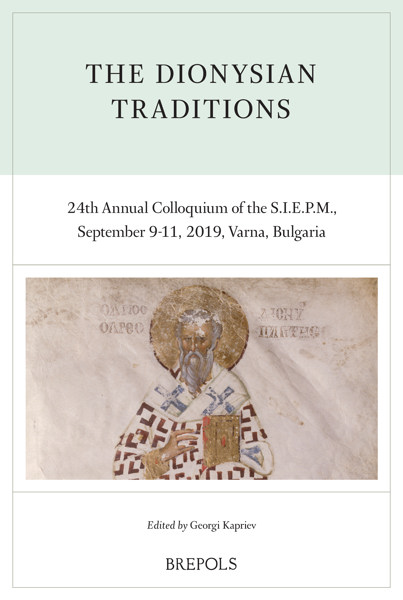
The Dionysian Traditions
View publication
This volume explores a range of theories and debates on foreknowledge (future contingents, prophecy, eschatology, scientific prognostication, and divination) across various disciplinary fields and medieval traditions.
Alessandro Palazzo is Ordinary Professor of History of Medieval Philosophy at the University of Trento. A specialist in medieval forms of prognostication, he recently co-edited Epidemics and Pandemics: Philosophical Perspectives (Turnhout: Brepols Publishers, 2024).
Francesca Bonini is Postdoctoral Fellow at the University of Trento, where she is part of the project Social, Political, and Religious Prognostication and its Roots: Philosophical Strategies for Coping with Uncertainties and Planning the Future. Her research focuses on the intersection between philosophy, theology, medicine, and astrology in the thirteenth and fourteenth centuries.
Amalia Cerrito was Postdoctoral Fellow at the University of Trento, where she worked on a project titled Between Science and Myth: Albert the Great, his Sources and his Followers. Her research focuses on the intersection between philosophy, medicine, and theology in thirteenth-century embryology.
This volume offers a comprehensive examination of medieval conceptions of foreknowledge—understood both as divine prescience and as the human capacity to anticipate future events—across a range of intellectual traditions. It investigates key themes such as future contingents, prophetic discourse (both divinely inspired and natural), divinatory dreams, eschatology, scientific prognostication (in astrology and medicine), and conjectural disciplines such as geomancy, physiognomy, meteorology, and magic. Through historical reconstructions and doctrinal analyses, the contributions illuminate the theoretical frameworks and distinctive positions advanced by medieval authors within diverse cultural and scholarly contexts. Building on an extensive body of prior research, the volume documents the multiplicity of medieval strategies for engaging with the future, thereby challenging the historiographical assumption that the notion of an open and indeterminate future emerged only in the Modern period.
Alessandro Palazzo (Università di Trento), Prognostication in the Middle Ages: Preliminary Remarks
Medieval Doctrines and Debates on Future Contingents, Prescience, and Freedom
Enrico Moro (Università di Padova), Anatomia della caduta. Agostino sulla compatibilità tra prescienza divina e libertà del primo peccato (lib. arb. III, 3, 6-8)
Pasquale Porro (Università di Torino), Does God Really Know Contingent Events as they Are? Revisiting (once again) the Consolation of Philosophy, Book V
Marcia L. Colish (†), Anselm’s Boethius: Necessity and Future Contingents in De concordia
Josep Puig Montada (Universidad Complutense de Madrid), Aristotle's Peri Hermeneias (c. 9) and its medieval Arabic translation. The first step toward a fruitful reception
Ginevra Tozzi, (IMT – Scuola Alti Studi Lucca), Future Contingents in Arabic Logic: Towards a Genealogy of Fārābī’s and Avicenna’s Commentaries on the Ninth Chapter of De Interpretatione
Martha Beullens (ULB), Connaître le futur. Le cas des futurs contingents ut in pluribus chez Albert le Grand
Amos Corbini (Università di Torino), Alcune polemiche di Ugolino di Orvieto sulla preconoscenza divina dei futuri contingenti
Riccardo Fedriga and Costantino Marmo (Università di Bologna), Rodolfo Brito sui futuri contingenti
Peter Hartman (Loyola University Chicago), The Presence of the Past: Durand of St.-Pourçain and Peter of Palude on Intuitive Cognition of the Past
Gonzalo Tinajeros Arce (Universidade de Brasília), Future Contingents in arguments of political censorship: Modal propositions in contrast. Solorzano Pereira Stands up to the censors of De Indiarum Iure (1638)
Prophecy in Jewish, Islamic, and Latin traditions
Meryem Sebti (CNRS), Déchiffrer l’Invisible : interprétation (ta‘bīr) et exégèse (ta’wīl) dans la philosophie islamique
Germano Gorga (IMT – Scuola Alti Studi Lucca), The Epistemology of Astrology and Prophethood from Abū Maʿšar to Avicenna’s Metaphysics
Ying Zhang (Shanghai – East China Normal University), The Most Perfect Prophet for Maimonides: Moses and Abraham in The Guide of the Perplexed
Anna Rodolfi (Università di Firenze), Angels and Prophets in Thirteenth-Century Latin Prophetology
Andrea Colli (Università di Bologna), The Church at the End of Times. Prophecy and Eschatology in Albert the Great’s Sermons and Biblical Commentaries
Paul Clarke, O.P., Prophecy’s Future and Prophecies Past: Thomas Aquinas, Peter of John Olivi, and the Prophetic Economy
Prognostic Sciences and Divination
Charles Burnett (The Warburg Institute – London) Scientia stellarum ex te et illis est: The Two Sources of Knowledge for Predicting the Future, in Pseudo-Ptolemy’s Centiloquium and Michael Scot’s Liber introductorius
Giulio Navarra (Università di Foggia), Celestial Influence and Astral Magic. Between the Ghāyat al-Ḥakīm and the ‘Kindī-circle Alexander’
Barbora Kocánová (Prague – Czech Academy of Sciences), Non-astrological Methods of Weather Forecasting in Medieval Latin Astrological Works: A Contradiction?
Alessandro Palazzo (Università di Trento), Geomantic Collections: Structure, Meaning, and Function
Jens Ole Schmitt (LMU Munich), Barhebraeus on Physiognomical Prognosis
Anna Gili (Università di Padova), Between Tradition and Medical Practice. Prognosis in al-Maǧūsī’s Kitāb al-Malakī
Mario Loconsole (Università del Salento), Somnium coadiuvat ad curationem. The Curative Power of Dreams in Pietro d'Abano's Conciliator
Roberto Limonta (Università di Salerno), Malae divinationes: Demons’ Foreknowledge and Semiotics of Lying in Augustine’s De divinatione daemonum
Vesa Hirvonen (University of Eastern Finland), Madmen’s special capacities in Nicole Oresme