Romanesque Cathedrals in Mediterranean Europe
View publication
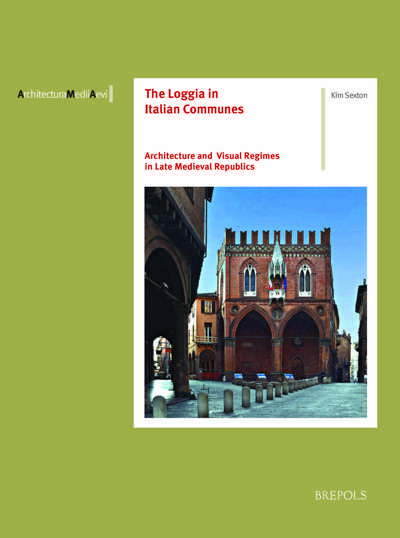
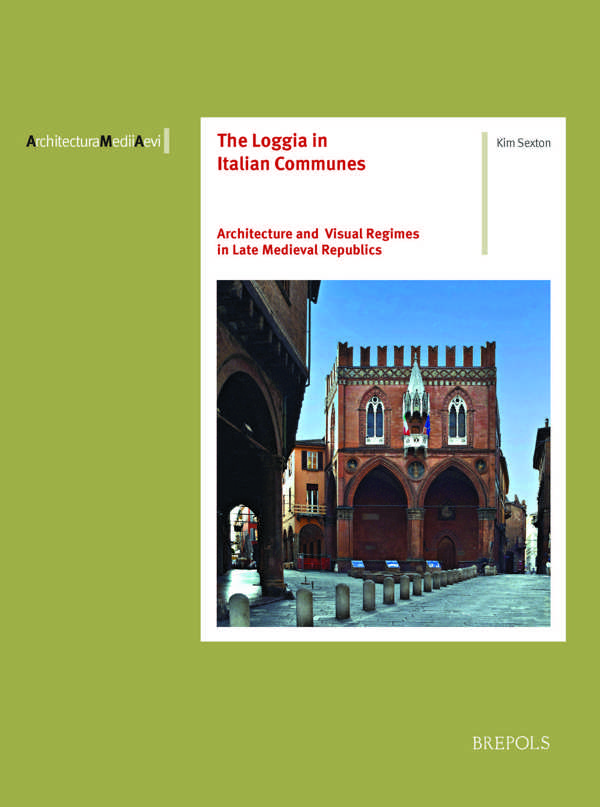
From the 11th century onwards, loggias put the new life-world of self-governing communes in Italy on view for a savvy public, showcasing leading citizens engaged in activities which, for the times, were ethically cutting-edge; in so doing, these deceptively simple buildings helped advance progressive attitudes toward commerce, sociability, and self-rule before the dawn of the modern era.
Kim Sexton, associate professor of architectural history at the University of Arkansas, specializes in the study of late medieval and Renaissance architecture in Italy and its intersection with politics and science. She has published articles on medieval loggias and spatial theory as well as medicine and the built environment. She edited the interdisciplinary volume Architecture and the Body, Science and Culture (2018). Her research for this book received support from the Gladys Krieble Delmas Foundation.
In this book, Kim Sexton offers a cultural history of loggias and their role in modernizing late medieval urban life in north and central Italy. In a narrative organized thematically around seismic ideological shifts in republican city-states from circa 1100 to 1400, she demonstrates that the loggia—a compact and refined form of portico—was much more than a convenient shelter on public squares and streets. Not only did loggias offer protection and adornment to both casual gatherings and ceremonial events, but they also functioned as societal tools that facilitated the collective validation of changing mores. Sexton argues that the increasingly monumental loggias commissioned by Italian communes for civic, commercial, and social settings reflects the influence of three secularizing trends: the process of political legitimation in self-governing, proto-capitalistic states, which required innovative, yet prestigious architectural forms to mediate unaccustomed rituals; the development of visual regimes that steered observers toward looking upon and remembering select public activities in a favorable light; and the rise of sophisticated temporal programs of ornament that rivaled ecclesiastical art in rhetorical force. Sexton further argues that both art and architectural historians can benefit from understanding the power of built form to exhibit human interaction, not only because loggias did so in a way that made architecture and spectacle seem indivisible and semi-pictorial, but also because a multi-disciplinary approach allows these highly elaborated spaces of encounter to emerge as key elements in theorizing the late medieval Italian city.
List of illustrations
Acknowledgements
List of abbreviations
Introduction: Seeing Loggias
Utilitarian Shelters and Instruments of Social Change
Framing the Loggia
Overview of the Chapters
Chapter 1: Justice
Laubiae in Carolingian and Ottonian Italy
The Social Landscape of Early Modern Loggias in Italy
Chapter 2: Law
Early Communes and the Challenges of Self-Governance
Northern Church Porticoes at the Dawn of the Communal Era
Podestas and Northern Communal Loggias
Milan’s Loggia degli Osii
Loggias and Mobile Urbanites in Milan
Loggias, Imaging, and Memory
Loggias and Communal Government in Rome
Early Seggi in the Kingdom of Naples
Chapter 3: Money
Medieval Cultures of the Coin
The Loggia of the Merchants in Venice
The Loggia of the Merchants as a Social Tool
Banking Porticoes: The Campo S. Giacomo at the Rialto
Affective Urbanism and Venice’s Money Loggias
Merchant Courts and Later Loggias
Chapter 4: Play
Opening Space for Public Leisure
Communal Leisure: Treviso’s Loggia dei Cavalieri
Class Segregation and Loggia Sociability
Urban Environments and Loggias for Play
Picture Perfect Leisure
Class, Gender, and the Social Space of Leisure
The Scourge of Gambling
Chapter 5: Politics
Republican Ideologies and Civic Loggias
The Framing of Republican Rituals in Florence
Civic Loggias as Symbols of Liberty
The Urban Calculus in Central Italy
Loggia Performances: A Citizen’s View
The Civic Loggia as Review Stand
Picturing Civic Loggias in Central Italy
The Loggia dei Lanzi’s Sculptural Program
Cross Currents
Conclusion
Bibliography
Index