Pursuing Middle English Manuscripts and their Texts
DISCOUNT PRICE
View publication
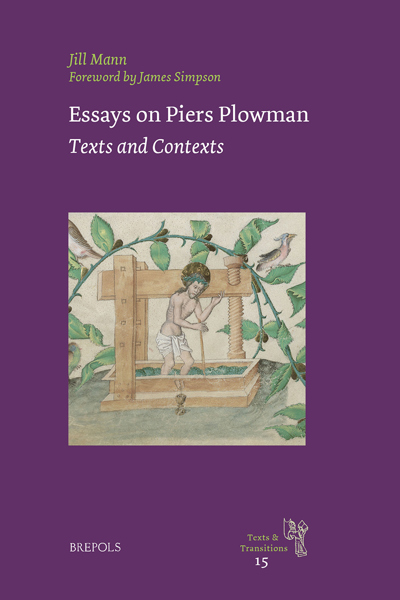
A collection of essays on Piers Plowman by a distinguished medievalist, some of which elucidate editorial methods and the relation of its three versions, while others explore its poetic imagery and use of allegory.
Jill Mann FBA is Emeritus Notre Dame Professor of English at the University of Notre Dame, and was formerly Professor of Medieval and Renaissance English at the University of Cambridge. She is the author of two books on Chaucer, and has edited the Canterbury Tales for Penguin Classics. She has also edited and translated two medieval Latin beast epics, and written a major book on medieval British beast literature, From Aesop to Reynard.
The late fourteenth-century Middle English poem Piers Plowman is often regarded by the modern reader as a difficult and challenging work in several respects. Its complex narrative mixes human individuals with personified abstractions and historical figures in unpredictable ways, and it is often punctuated by lengthy discussions of religious doctrine or social issues. It is written in an unfamiliar alliterative metre, and incorporates frequent quotations from the Bible in Latin. In consequence, critical work has often been dedicated to explanatory analysis which overlooks the poetical qualities of the work.
This collection of essays aims to redress the balance by approaching the poem from another direction altogether: Langland’s poetic creativity. The essays on Langland’s allegory show that it does not reduce the world to a set of abstract non-entities, but rather arises spontaneously and naturally from everyday use of language: as nouns combine with verbs, they spring into action and interact with human individuals to form the drama of human life in the bustling world of fourteenth-century society. Langland’s language is ‘instinct with life’, and shows how that life takes place at the intersection of the material and the spiritual. Latin quotations provide a rich store of images that structure the whole poem, one metaphor linking with another until they create a whole parallel world that gives the material an extra dimension and significance. Other essays deal with some of the ‘difficult’ aspects of the poem: the methods of editing a poem that survives in over fifty manuscripts, or alliterative metre, or the relation of the three major versions of the poem, and its relation to its historical context.
Foreword, by James Simpson
Textual Studies
The Power of the Alphabet: A Reassessment of the Relation between the A and the B Versions of Piers Plowman’
The Poetics of Editing: In Memory of George Kane
Some Observations on ‘Structural Annotation’
Was the C Reviser’s Manuscript Really So Corrupt?
Revisiting the B A Relationship
Poetic Imagery and Allegory
Langland and Allegory
Piers Plowman and the Allegorical Tradition
Allegorical Buildings in Medieval Literature
Eating and Drinking in Piers Plowman
Opening and Closing: Doors, Gate, Hinge, Hasp, Locks, Treasure, Prison, Coin, Seal
The Nature of Need Revisited
Nature, God, and Human Society in Piers Plowman
Excursus: A Note on B.19/C.21.187: ‘kneweliche to paye’
***
Bibliography
Index