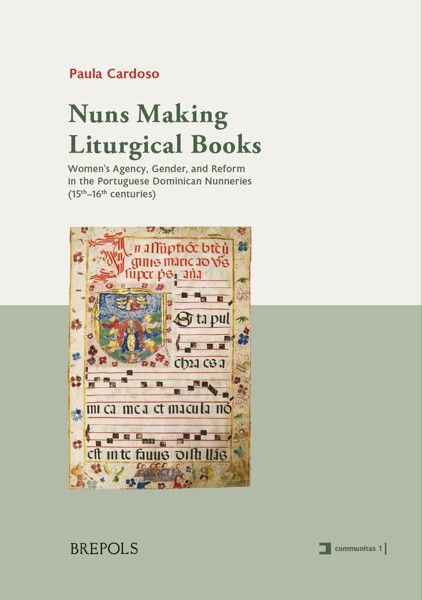
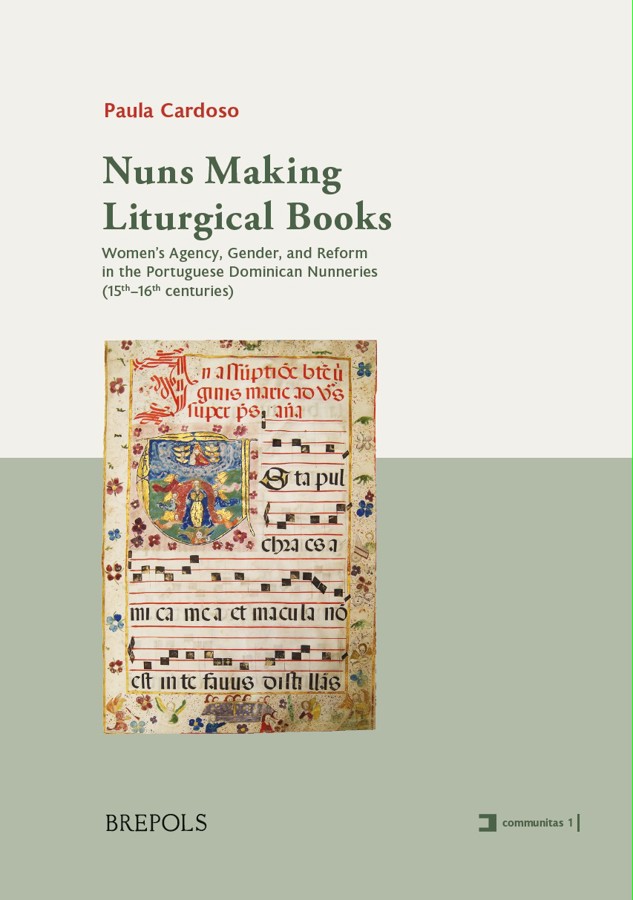
Nuns Making Liturgical Books
Women’s Agency, Gender, and Reform in the Portuguese Dominican Nunneries (15th-16th centuries)
Paula Cardoso
- Pages: 188 p.
- Size:178 x 254 mm
- Illustrations:28 col.
- Language(s):English
- Publication Year:2027
- € 85,00 EXCL. VAT RETAIL PRICE
- ISBN: 978-2-503-61616-2
- Hardback
- Forthcoming (Mar/27)
- € 85,00 EXCL. VAT RETAIL PRICE
- ISBN: 978-2-503-61617-9
- E-book
- Forthcoming
*How to pre-order?
When analysed within their context of production, and in conjuction with other surviving sources, the manuscripts from the Observant Dominican convents of Portugal reveal new information on the nuns’ education, identity and communal memory, evincing how these were interrelated with the reformist environment in which these convents originated.
Paula Cardoso holds a doctorate in Art History from the Universidade Nova de Lisboa. She is currently a contracted researcher at the Instituto de Estudos Medievais of the Universidade Nova de Lisboa and a former Marie Curie Postdoctoral Fellow at Universitat Pompeu Fabra (Barcelona). Her work has been devoted to the interrelations between convent culture, religious praxis and identity in the mendicant nunneries of late Medieval Portugal, namely through the interdisciplinary study of liturgical books, texts and artworks.
Nuns Making Liturgical Books examines how Portuguese Dominican nuns exercised agency and expressed religious authority through the production, commissioning, and use of liturgical books. Rather than treating these volumes as mere repositories of text, this study considers their materiality, context of production, and functionality, approaching them as tangible evidence of the women who created and used them.
Although these books were largely modelled on the Dominican order’s official liturgy—reflecting the reformist environment in which these convents were established—a contextual analysis alongside contemporary sources demonstrates that they were equally shaped by the specific needs and circumstances of their communities.
Portuguese Dominican nuns commissioned, copied, and illuminated liturgical books for their convents, occasionally recording their names and roles in colophons. Analysing their textual and visual choices alongside their actual liturgical practice, and comparing them with those of their male counterparts, reveals how gender informed these women's cultural production, and how these choices served as active strategies to advance religious reform, shape communal identities, and assert religious authority.
Introduction
Chapter 1. Women and the Reform of Female Mendicancy in Portugal
Chapter 2. Shaping Observant Communities. Nuns, Learning, and the Production of Liturgical Books
Chapter 3. Liturgical Books, Gender, and Religious Identity. Reconciling the Order’s Norms with the Practice of the Nuns
Chapter 4. Art and Book Decoration in the Dominican Order
Chapter 5. Defining Their Own Images. Illuminating Liturgical Books for Dominican Women
Conclusion