De l’expertise artistique à la vulgarisation au siècle des Lumières
View publication
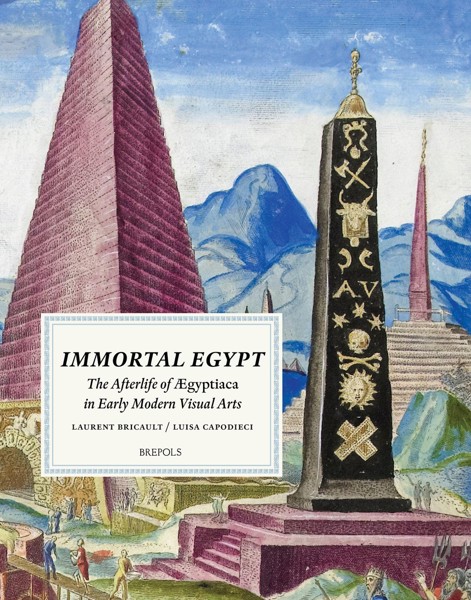
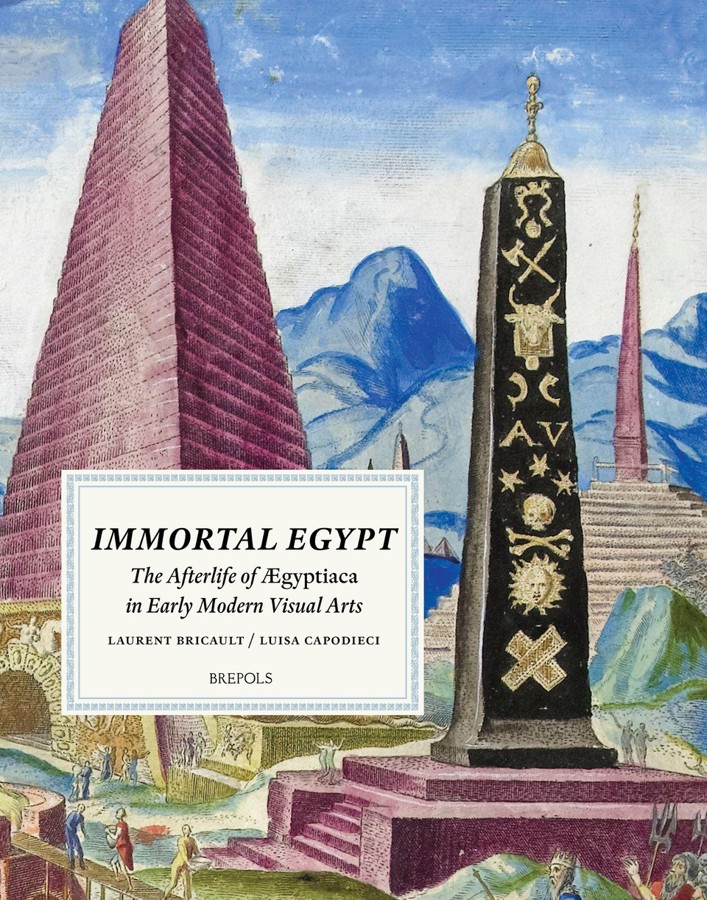
This book explores the interaction between continuity, discontinuity, survival and rebirth by employing the epistemological tools of art history, visual anthropology and the history of ideas in order to reflect on the heritage, as well as on the creative processes that have ensured the posterity of Egypt.
Luisa Capodieci Ph.D. (Paris 1 Panthéon-Sorbonne 2005) is Associate Professor in Modern Art History at the Université Paris 1 Panthéon-Sorbonne. She was fellow at The Harvard Center of Italian Renaissance Studies - Villa I Tatti and long-term Frances Yates fellow at the Warburg Institute. She has published a number of studies on Art, Astrology, Hermeticism and Neoplatonism focusing on the relations between France and Italy, in particular, the Valois Court and the Medici. She is the author of L’œil d’Osiris. Vision de l’Égypte dans l’art profane de la Renaissance entre France et Italie (forthcoming) and Medicæa Medæa. Art, astres et pouvoir à la cour de Catherine de Médicis (Geneva, 2011). She has also collaborated on exhibitions on the Renaissance in France and in Italy.
Laurent Bricault Ph.D. (Paris-Sorbonne 1994), is Professor of Roman History at the Université Toulouse Jean-Jaurès and senior member of the Institut Universitaire de France. Well known in the domain of Isis studies, he is the author of numerous books and articles. He has recently published Isis Pelagia: Images, Names and Cults of a Goddess of the Seas (Leiden, 2020), and Isis Moneta. The 'Vota Publica' tokens from late antique Carthage and Rome, together with C. Mondello (London, 2023). He is also the co-curator of the international exhibition “The Mystery of Mithras: Exploring the Heart of a Roman Cult” presented in Belgium, France and Germany (2021-2023).
This book is devoted to the way in which artists, travellers and scholars of the Renaissance and Early Modern periods looked at the land of the pharaohs, and how their works reflected the thousand facets of Egypt through the ages. The approach is resolutely innovative, favouring the cross-views of specialists in Antiquity and art historians on common themes. In a fruitful and fertile dialogue, during three symposia held in London, Rome and Paris, they questioned and explored the metamorphoses and anamorphoses of the ægyptiaca in the European imaginary between the 15th and 19th centuries. The Egypt that emerges is less a place than an idea, less a historically determined reality than a figure of cultural memory. This Egypt, teeming with monuments, gods and signs, in perpetual re-creation, appears as an infinite and timeless land, whose origins lie in a bygone past, at the beginning of the world. An immortal Egypt.
Introduction
Luisa Capodieci et Laurent Bricault, Egypt Through the Lens of Modern Europe
MONUMENTS
TRAVELS
Ian Rutherford (University of Reading), Early Modern Visitors to Egypt and their Use of Classical Sources
Anne Haslund Hansen (The National Museum of Denmark, Copenhagen), F.L. Norden’s Voyage d’Égypte et de Nubie, 1755: Image Production and Circulation
OBÉLISKS AND PYRAMIDS
Jean Winand (Université de Liège), Les obélisques romains de Kircher ad maiorem Dei gloriam ou les obélisques égyptiens comme membra disjecta de la prisca theologia
François de Callataÿ (Bibliothèque Royale de Belgique, Bruxelles), The pyramid motifs on medals before 1822 : long a very German immortality
SPHINXES
Giuseppina Capriotti (Istituto di Studi sulle Civiltà Italiche e del Mediterraneo Antico, Roma), Inventio Aegypti: Transmission, Knowledge and Interpretation: The Sphinx in the Middle Ages between Rome and Apulia
Damien Ag ut-Labordère (CNRS), De Saïs à Paris, en passant par Rome, l’origine des sphinx de Néphéritès et d’Achoris (Louvre N 26 et N 27)
Jean-Marcel Humbert (Musées de France), De Rome à Paris, les sphinx égyptisants au tournant de la fin du XVIIIe siècle
GODS AND HUMANS
ISIS ET ALII
Laurent Bricault (Université de Toulouse Jean Jaurès), Isis myriomorphos in 4th century Rome
Stéphane Rolet (Université Paris 8 Vincennes Saint-Denis), Was Pierio Valeriano an Egyptologist? Considerations on the 39th Book about Isis in the Hieroglyphica (1556)
CLEOPATRA
Bernard Legras (Université Paris 1 Panthéon-Sorbonne), Cléopâtre VII devant le tribunal de l’Histoire dans l’Empire romain
Laurent Bricault (Université de Toulouse Jean Jaurès), L’Égypte de Louis Gauffier, de Rome en Alexandrie
ANTINOUS
Caroline Vout (Cambridge University), Antinous ancient and modern: an image between Egypt, Greece and Rome
Luisa Capodieci (Université Paris 1 Panthéon-Sorbonne), « Ornements sans nom ». La Renaissance extravagante du Ciocio-Osirantinoos
SIGNS
HIEROGLYPHS AND SIGNA
Jean Winand (Université de Liège), A World of Ideas without Words: Renaissance Hieroglyphs between Tradition and Innovation
Anne Rolet (Université de Rennes 2), The Veil of Symbol or the Hieroglyphic Illusion: Egyptian Gods and Writing and their Uses in 16th cent. Emblematic Collections
Florian Ebeling (Heidelberg Universität), Egypt as the Epitome of Symbolism, Freemasonry and Warburg’s “Nachleben”
HOROSCOPES AND MAGIC
Korshi Dosoo, (Julius-Maximilians-Universität, Würzburg), Aesthetics and Power: Egyptian Image-Magic in the Roman Empire
Thomas Galoppin (Université de Toulouse Jean Jaurès), Capturing the Phoenix on Magical Gems: Lives in a Circle and a Cycle of Life
ATTRIBUTES AND ANIMALS
Richard Veymiers (Musée royal de Mariemont / Université de Liège), Les dieux-serpents égyptiens. Du sens et de l’usage d’une série de petites stèles en pierre
Sidney Aufrère (CNRS), La reviviscence des dieux égyptiens : des aquarelles de Nicolas-Claude Fabri de Peiresc aux dessins des jeunes savants de « l’Académie du Kaire »
CONCLUSION
Miguel John Versluys (Universiteit Leiden), Egypt as provocation