
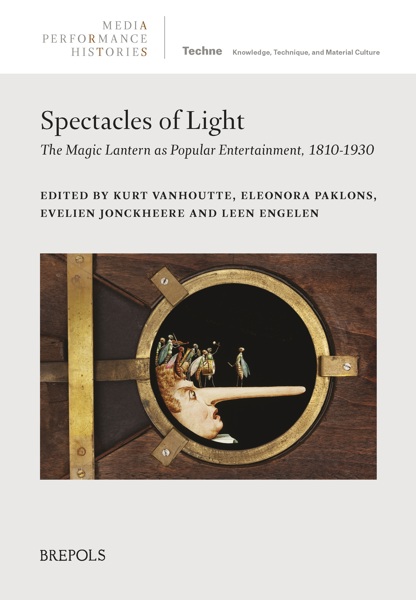
Spectacles of Light
View publication
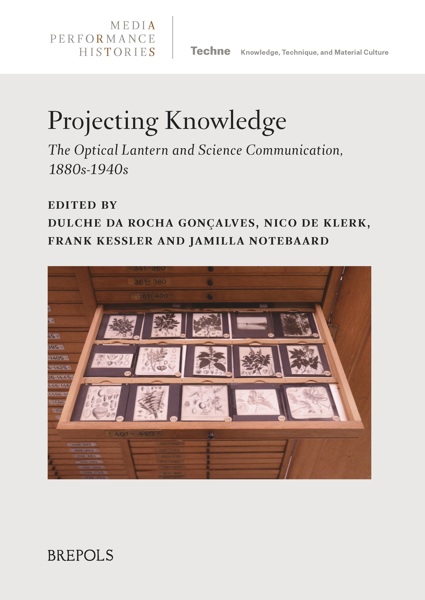
The volume focusses on the role of the optical lantern in knowledge transmission.
Dulce da Rocha Gonçalves is a historian interested in the cultural dimensions of media, science, and technology. She earned her PhD at Utrecht University within the research project Projecting Knowledge, producing the first large-scale survey of public lantern lectures in Dutch society from the late nineteenth century to the Second World War. She currently holds a postdoctoral position in the Technology, Innovation & Society group at Eindhoven University of Technology.
Nico de Klerk is an independent researcher and archivist in the field of film and media history. Between 2018 and 2023, he was a postdoctoral researcher in the project Projecting Knowledge at Utrecht University, which partly overlapped with his research for the project Educational Film Practices in Austria, 1918-1970, at the Ludwig Boltzmann Institut for Digital History, Vienna. His current research focuses on the film-illustrated lecture in the Netherlands between c. 1910 and 1940.
Frank Kessler is professor emeritus of Media History at Utrecht University. He is one of the founders of KINtop. Jahrbuch zur Erforschung des frühen Films and the KINtop – Studies in Early Cinema book series. His research interests focus on the emergence of cinema as a multi-facetted medium and a cultural form, as well as on nineteenth-century visual media. His most recent research is dedicated the optical lantern as a tool for knowledge communication.
Jamilla Notebaard is a historian whose doctoral research explored the use of the magic lantern in Dutch academic education at the end of the nineteenth century. Her work reflects a deep interest in the history of science, particularly in the epistemic role of images in shaping knowledge within scholarly communities and beyond. She investigates how visual representations function as carriers of meaning, influencing both collective understanding and individual perception.
From the 1880s until well into the twentieth century, the optical lantern was an immensely important tool to disseminate knowledge both within and outside academia, particularly in Western Europe and the United States. This volume maps the lantern-illustrated lecture from various perspectives, with contributions on how to research historical audiences, on the spaces where projection was used, on the role of images as evidence, on the shifts in pedagogy that were supported by the projected image, and on the archives and sources that provide access to material that allows an understanding of the multiple ways in which the medium was used.
Introduction (NdK & FK)
1. Audiences
Annelies Andries, “Imag(in)ing Audiences: The First Parisian Hippodrome”
Klaas de Zwaan, “From Mass to Micro Medium: Understanding Lantern Lecture Audiences”
2. Pedagogy
Bert Theunissen, “From Bildungsbürger to Researchers. The Transformation of Academic Education in the Nineteenth Century”
Laurens de Rooy: “The Anatomist’s Toolbox: Teaching Anatomy in Amsterdam 1880-1940”
Jamilla Notebaard: “The Visual Strategies of Plant Movement: A Historical Analysis of the Teaching Practices of Professor F.A.F.C. Went (1863-1935)”
3. Images
Alison Griffiths, “Defamiliarizing the Lantern Show: Thoughts on Wonder and Decolonial Methodologies”
Scott Curtis; “Projected Photographs as Evidence: Testimony and Efficiency”
Frank Kessler, “Performing Evidence in Illustrated Lantern Lectures”
4. Spaces
Martin Bush, “The Planetarium in Space”
Christian H. Stifter, “Vivid and Captivating Knowledge Transmission: The educational use of lantern slides in the early days of the Vienna Urania, 1897-1914”
Dulce da Rocha Gonçalves, “Welbehagelijke Zaaltjes and Dorpscafés: Lantern lecture venues in the Netherlands after 1900”
5. Archives and Sources
Interview with Trienke van der Spek, “Illustrated Lectures at Teylers Museum, Haarlem”
Anke Napp, “Time Capsules: Lantern slides in their media-archaeological environment at the Seminar of Art History at the University of Hamburg”
Nico de Klerk, “Imperfect Camouflage: Reviewing Public Illustrated Lectures in Dutch Newspapers, 1890-1940”
Afterword, Paul Ziche