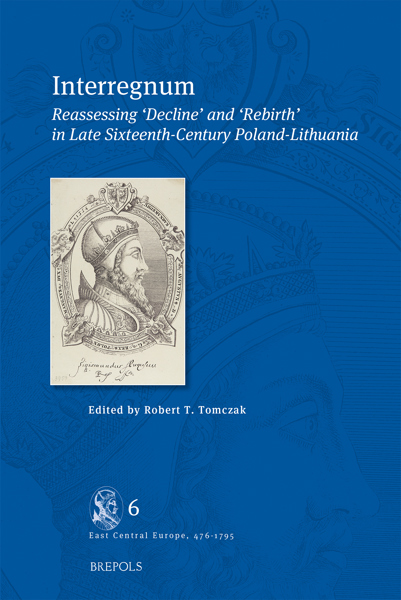
Interregnum
View publication
Bona Sforza (1494–1557) was a key figure in the political, diplomatic, and economic life of early modern Europe. This volume explores Bona Sforza’s political life and the ways she exercised power, integrating research on artistic, literary, and other forms of cultural patronage exercised by elite women with analysis of the economic forms of power.
Darius von Güttner-Sporzyński is a historian of East-Central Europe, specialising in the political, cultural, and religious history of the late medieval and early modern periods. His research centres on the Jagiellon dynasty, queenship, and the relationship between power, belief, and material culture in Poland-Lithuania and neighbouring regions. At Australian Catholic University, he is Campus Dean (Canberra) and Professor of History, contributing to teaching, research leadership, and curriculum development. He is actively engaged in shaping interdisciplinary approaches that connect historical inquiry with broader questions of society and culture. He is a Fellow of the Royal Historical Society and the Royal Society of Arts.
Agnieszka Januszek-Sieradzka is a historian specialising in the late medieval and early modern history of Poland, with particular expertise in royal courts, court culture, and the Jagiellon monarchy. Her research focuses on the structures and practices of royal and queenly courts, as well as the cultural and political roles they played within the Polish kingdom. She is a professor at the John Paul II Catholic University of Lublin, where she contributes to teaching and research in medieval history. Her work is grounded in close analysis of narrative and documentary sources, with a strong emphasis on courtly institutions and cultural practices. She is the author of studies on royal residences and court culture, including her monograph Curia regis, curia reginalis, which examines the royal and queens’ courts in the Jagiellon period. She also authored Królowa Barbara Radziwiłłówna w dworskim mikroświecie (2017), a study of queenship and courtly life in the Jagiellon period. She is a member of the Committee of Historical Sciences of the Polish Academy of Sciences.
Bona Sforza (1494–1557) was a key figure in the political, diplomatic, and economic life of early modern Europe. The niece of Lucrezia Borgia, she was an economic innovator and reformer and patron of architecture and the arts. Bona was the legitimate heir to the Sforza throne of Milan, Queen Consort of Poland, Duchess of Bari, and Princess of Rossano, and claimant to the crown of the Latin Kingdom of Jerusalem, the latter Italian possessions inherited from her mother in 1524.
This volume brings together studies of diverse aspects of the Queen’s activity. The authors examine Bona’s immediate economic, political, and cultural impact, the resentment expressed by Poland’s oligarchs, and a heavily gendered yet appreciative popular response. This collection of studies will contribute to the consideration of women’s dynamic and relational concept of agency from a historical perspective by exploring the circumstances under which women rise above their restrictive situations and illuminate the factors (age, political or economic climate) that determined their ability to manage their own lives.
New Studies and Sources on the Practice of Rulership of Queen Bona Sforza
Chapter 1. Bona Sforza: Queen of Poland and Grand Duchess of Lithuania
DARIUS VON GÜTTNER-SPORZYŃSKI
Chapter 2. Bona Sforza and the Grand Duchy of Lithuania
RAIMONDA RAGAUSKIENĖ
Chapter 3. Bona Sforza and the Legal Culture of the Grand Duchy of Lithuania
RASA LEONAVIČIŪTĖ-GECEVIČIENĖ
Chapter 4. Queen Bona Sforza and Her Three Daughters-in-Law
AGNIESZKA JANUSZEK-SIERADZKA
Chapter 5. Witchcraft and Power at the Court of Queen Bona
EWA LETKIEWICZ
Chapter 6. Queen Bona’s Records in the Chancellery of the Grand Duchy of Lithuania
KRZYSZTOF PIETKIEWICZ
Chapter 7. Contested Will and Testament of Bona Sforza: The Documentary Evidence of the Mediation by Ferdinand I
JÚLIA BENAVENT
Chapter 8. The Portrait Medals of Sigismund I: Their Makers and Impact
MATEUSZ GRZĘDA
Chapter 9. The Prayer Book of Queen Bona in the Bodleian Library
RAFAŁ WÓJCIK
Chapter 10. Queen Bona Sforza’s Prayer Book in the Collection of the Royal Castle in Warsaw
KATARZYNA KRZAK-WEISS
Index