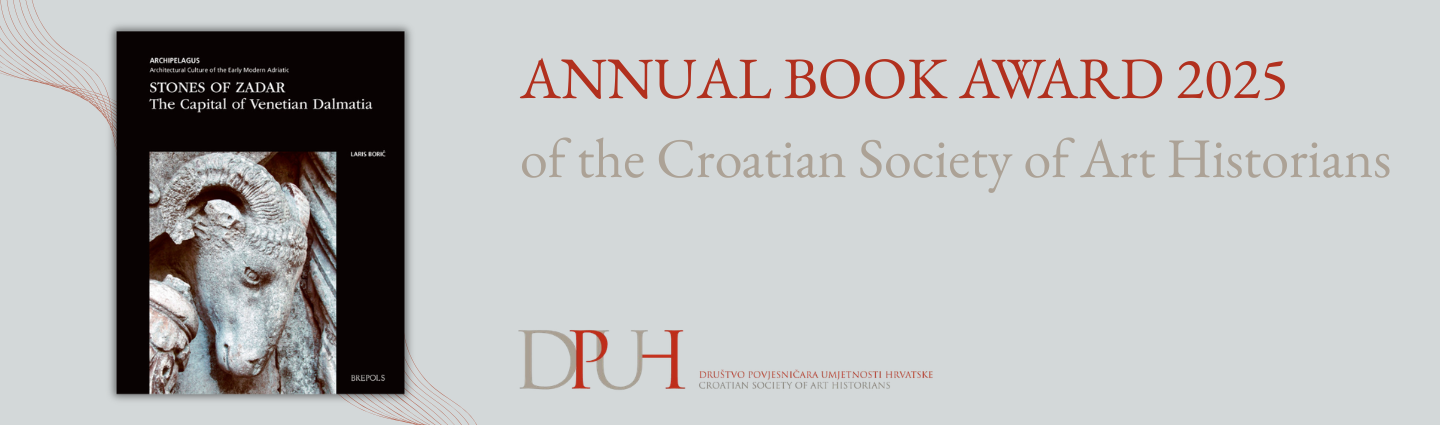
The Committee for the Award of the Croatian Society of Art Historians grants the award in the category of scholarly or professional book to Dr. Larisa Borić for the monograph In between and on the Edge: Stones of Zadar, the Capital of Venetian Dalmatia, published in the international series Archipelagus. Architectural Culture of the Early Modern Adriatic.
This scholarly grounded and methodologically innovative monograph offers a comprehensive interpretation of the architecture and sculpture of Zadar under Venetian rule from the mid-fifteenth to the end of the sixteenth century. The author approaches the material from a new perspective, examining architecture through the prism of sculpture and thereby placing at the centre of the study the work of stonecutters and builders who, in collaboration with patrons, shaped the visual identity of Renaissance Zadar. In doing so, Borić systematically connects previous scholarship with new archival findings, reinterprets well-known material, and presents a series of new discoveries, conclusions, and interpretations.
The particular value of the book lies in its problem-oriented approach and broad social contextualization, through which the author considers architecture and sculpture within the political, economic, and social circumstances of Venetian Dalmatia. The analysis of patrons, workshops, and artistic networks enables an understanding of the complex relationships between the local milieu and the Venetian cultural sphere, convincingly illuminating the specific features of Zadar’s artistic production. Borić skillfully employs contemporary methodological approaches, combining comparative and stylistic analysis with iconographic and semantic interpretation, while also incorporating interdisciplinary perspectives drawn from cultural anthropology and social history.
An important contribution of the monograph is its extensive use of archival sources, many of which are here systematically analyzed and interpreted for the first time. The author successfully connects fragmented data into a coherent whole, offering a new synthesis of the development of architecture and sculpture in Renaissance Zadar. As such, this monograph represents a significant contribution to both Croatian and international art history and opens new perspectives for future research.
By being published by a prestigious international publishing house and made available in open access on the BrepolsOnline platform, Larisa Borić’s book significantly contributes to the international visibility of Croatian artistic heritage and contemporary research in Croatian art history. The Committee therefore recognizes this monograph as an outstanding scholarly contribution and awards it the annual prize of the Croatian Association of Art Historians.