
Means of Christian Conversion in Late Antiquity
View publication
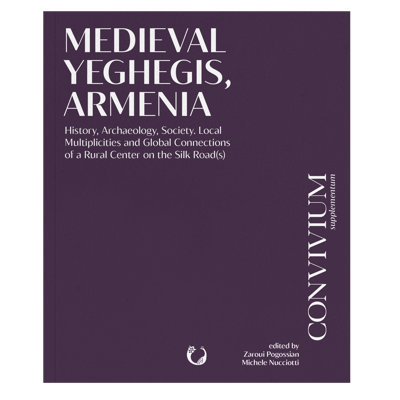
This collective volume explores the rich history and archaeological heritage of Yeghegis, a modest village nestled in the Vayots’ Dzor region of Armenia, historically a part of the Syunik’ province. By examining its multifaceted past, the book underscores Yeghegis’ pivotal role as a nexus within medieval networks of political authority, as well as cultural and commercial exchanges, shedding light on its importance in the broader socio-economic landscape of the period between the 9th and 14th centuries. The pioneering articles in the collection provide a comprehensive study of Yeghegis’ splendid material cultural legacy through the application of archaeological, stratigraphic methodologies for the first time, as well as through the lens of archaeology of production and ‘light archaeology’. By integrating perspectives from the broader framework of the medieval global context with a meticulous analysis of local (including inter-dynastic) dynamics, the research redefines Yeghegis’ role as a ‘central place’ in the Middle Ages. Notably, the volume includes a detailed topographical and epigraphical analysis of its Jewish cemetery, the patronage of arts and architecture by its Syuni and Ōrbēlean princes, its tri-lingual grave and its significance, as well as a full collection of Yeghegis’ Armenian epigraphic corpus accompanied by its first English translation. This reevaluation not only enhances our appreciation of Yeghegis’ monuments’ artistic prominence, long recognized as key specimens of medieval Armenian architecture, but also illuminates on its manifold linguistic, religious, and cultural landscape.
Introduction
Zaroui Pogossian & Michele Nucciotti
A Rural Center on the Silk Road: Introduction to an Interdisciplinary Study of the Village Yeghegis
Chapters
Zaroui Pogossian
Vayots‘ Dzor, Syunik‘, and the World: Global Transformations and Local Dynamics between the 9th and 14th Centuries
Zaroui Pogossian
The Golden Age of Yeghegis in the 13th and 14th Centuries: Built Environment, Cultural Heritage, and Local Multiplicities
Michele Nucciotti
Light Archaeologies and Territorial Histories of Medieval Yeghegis
Elisa Pruno
The Stone Production in Medieval Yeghegis. Raw Materials, Products, and Toolmarks
Tatyana Vardanesova
Retracing the Silk Road. Vayots‘ Dzor Through Medieval Ceramic Artifacts
Michele Nucciotti & Francesca Cheli
The ‘Old Church’. An Archaeological Stratigraphic Analysis
Cecilia Luschi & Laura Aiello
Appendix. The Old Church: An Architectural Description
Mariana De Falco & Leonardo Squilloni
The Cupola Church. An Archaeological Stratigraphic Description
Cecilia Luschi & Marta Zerbini
Appendix. The Cupola Church: An Architectural Description
Francesca Cheli & Diletta Bigiotti
The Zorats‘ Complex. An Archaeological Stratigraphic Description
Cecilia Luschi, Francesco Trovatelli & Alessandra Vezzi
Appendix. The Zorats‘ Church: An Architectural Description
Michele Nucciotti, Elisa Pruno & Lapo Somigli
Yeghegis Atlas of Masonry Types
Hamlet Petrosyan & Zaroui Pogossian
Armenian Inscriptions From and Around Yeghegis
Michael Pifer
Reading the Trilingual Gravestone of Yeghegis. On Multilingualism in Medieval Armenia
Alexandra Cuffel
The Jewish Cemetery in Yeghegis in its Wider Context
Conclusion
Vasco La Salvia
As an Epilogue. Historical Insights and Methodological Approaches: Rethinking Yeghegis in the Context of Local Dynamics and Global Networks