Accounts and Accountability in Late Medieval Europe
View publication
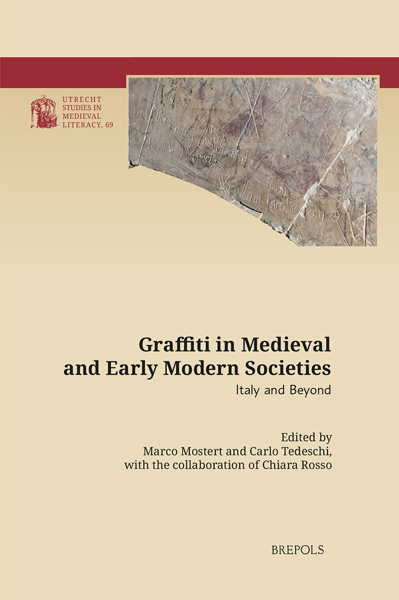
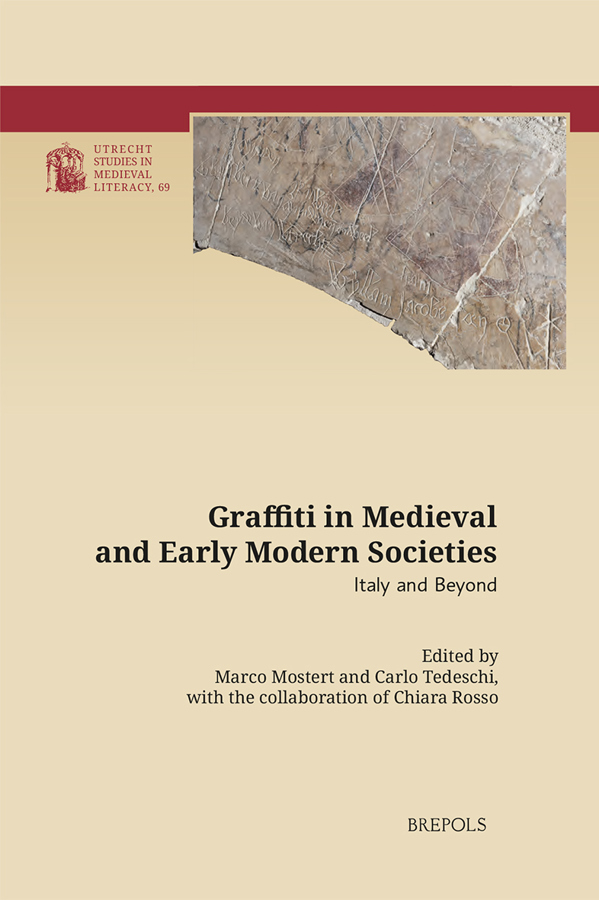
This book discusses a wide variety of approaches to the making, using, and keeping of graffiti in medieval and early modern societies.
Carlo Tedeschi is Professore Ordinario of Palaeography at the "G. d'Annunzio" University of Chieti-Pescara.
Marco Mostert is Professor Emeritus of Medieval History at Utrecht University.
Graffiti is increasingly being recognised as an important historical source that can provide first-hand information on the written cultures of past societies. This book presents a wide variety of approaches to the how and why of graffiti production in medieval and early modern societies. Geographically, the book ranges from Italy to Russia, by way of the insular and Nordic worlds, and beyond, to the Holy Land and early medieval Nubia. Attention is given to information which will lead to the development of the historical criticism of graffiti, including the best practices for photography. A bibliography of the publications on medieval graffiti which have come out since 2000 is hoped to further the development of future scholarship.
While there is extensive scholarship on graffiti in classical Antiquity, other historical graffiti remains understudied. This volume provides an overview of studies on graffiti for medieval and early modern cultures as well as a platform for future research.
Preface
By Way of an Introduction: Some Thoughts on Graffiti as a Historical Source
CARLO TEDESCHI
Graffiti, Margins, and Palimpsests
VÉRONIQUE PLESCH
At the Margins of Graffiti: ‘Fixed’ Writings in Pilgrimage Sites in the Holy Land
CLÉMENT DUSSART and ESTELLE INGRAND-VARENNE
Inscriptions and Graffiti from the Courtyard of the Armenian Monastery of Sts. James in Jerusalem
KHACHIK HARUTYUNYAN
Devotional Graffiti in Christian Nubia (Based on the Material from the So-Called North Church within the Monastery on Kom H in Dongala)
ADAM ŁAJTAR
From the Pillar to the Page: Historic Graffiti in British Churches and Medieval Graphic Practice
WENDY SCASE
Memorial Graffiti and Libri vitae: An Intersection?
LAURA PANI
Graffiti and the History of the Italian Language: Some Case Studies from "Italia Mediana"
ALICE DI COCCO
Connections between the ‘Global’ and the ‘Local’: Exploring Marginality through Late Fourteenth-Century Graffiti near Verona
GIULIA SACCOMANI
Cavernae solertes inquisitores: Graffiti on a Sixteenth-Century Speleological Exploration in Martina Franca
CRISTINA COMASIA ANCONA and ROBERTO ROTONDO
Digital Photographic Reproduction Techniques for Studying Graffiti
ROCCO D’ERRICO
"Thorgrim Owns Me": Runic Graffiti of Lydvaloftet, a Medieval Farmhouse at Voss, Norway
KRISTEL ZILMER
The Place of Graffiti in the Graphic Environment of Medieval Rus
JOS SCHAEKEN
Graffiti in Medieval Written Culture and in the Graphosphere
MARCO MOSTERT
After Kraack and Lingens: An Additional Bibliography on Medieval Graffiti
MARCO MOSTERT
Notes on Contributors