Le Grand livre de choeur de la cathédrale Saint-Lambert de Liège
View publication
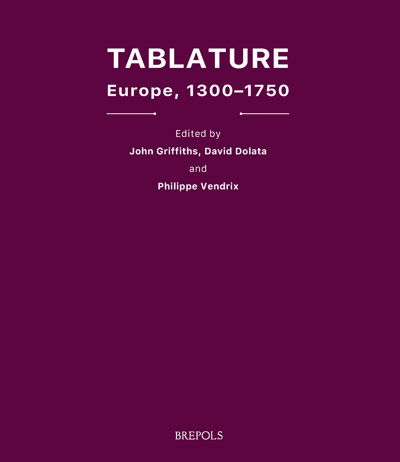
Tablature: Europe 1300-1750 offers an encyclopaedic panorama of the variety of tablatures that formed part of the Western musical mainstream until c.1750.
John Griffiths is a professor at the University of Melbourne, a research associate of the Centre d’études supérieures de la Renaissance and an active researcher in the field of early instrumental music.
David Dolata is Professor of Musicology at Florida International University in Miami, where he coordinates the music history area and teaches graduate seminars in research methods, performance practice, and performance styles.
Philippe Vendrix is a research director at the CNRS and a member of the Centre for Advanced Studies of the Renaissance (Tours), where he coordinates the activities of the RicercarLab.
Tablature is a generic term for music written as a table or a score, most often using letters or numbers instead of conventional music notation. It was mainly used for solo instruments such as keyboards, lutes and guitars and was a mainstream notation until the mid-eighteenth century. Tablatures were also used for many single-line instruments—strings, winds, and brass—as well as the human voice. Composers and choir masters were among the other musically bilingual musicians who used tablature in their professional lives. Tablature was the most natural way to write music in score until conventional notation was gradually adapted for score writing during the seventeenth century.
Tens of thousands of tablature works survive from the early modern period until c.1750. Often dismissed as eccentric and impenetrable, tablature has frequently been seen as an obstacle, and often overlooked in music history studies. One of the principal aims of this book is to break down the barriers that have hindered the general assimilation of tablature repertories into the way we understand music of the past. Chosen from among thousands of surviving sources, this book presents a representative group of 435 tablatures selected by a team of leading international scholars to show the beauty, diversity, and practicality of the notation. For each chosen work, a facsimile shows the original notation and is accompanied by a modern transcription and commentary to demystify music that has too frequently been regarded as obscure or enigmatic.
List of Works
Introduction
Acknowledgements
Instruments & Tablatures
Angelique
Bandora and Orpharion
Bandurria
Baryton
Calichon and Mandora
Cimbalom
Citrinchen
Cittern
Guitar
Harp
Hunting horn
Keyboard
Lira da braccio
Lirone
Lute
Mandolino
Mandore
Musette
Recorder and Flageolet
Sordellina / Buttafuoco
Theorbo
Tromba marina
Trumpet
Vihuela
Viola da gamba and Lyra viol
Violin
Voice
Bibliography
Image credits