The Commentaries on Boethius
View publication
“The Memory of Past Acts is a marvelous book, surely the most ambitious and interesting to have been written on cartularies for a long time. Scholarship on the subject since the 1990s has, with few exceptions, progressed in the form of regionally focused conference volumes, specialized articles, and chapters within monographs devoted to other subjects. The geographical and chronological breadth on display in Robert Maxwell’s study, with its deft melding of diplomatic and art historical analysis, is refreshing and impressive, and supports an original and theoretically sophisticated treatment of medieval documentary culture.”
Adam Kosto, Columbia University
“Robert Maxwell’s critical revaluation of medieval illuminated cartularies brilliantly demonstrates how visual images contribute to “cartularization,” the process of selectively assembling within a single codex the disparate charters containing legal privileges, grants of territory, and acts of foundation from different periods to narrate or rewrite an institution’s history. The author offers convincing evidence of the various ways that images and graphic marks – portraits, seals, depictions of ceremonial acts – enhance the “artifactual value” of cartularies as material representations and living presences of past historical performances.”
Thomas E. A. Dale, University of Wisconsin–Madison
Robert A. Maxwell is Sherman Fairchild Associate Professor of Fine Arts at the Institute of Fine Arts, New York University. The author of The Art of Medieval Urbanism: Parthenay in Romanesque Aquitaine (2007) and editor of Representing History, 900–1300: Art, Music, History (2010), he is also co-editor, with Kirk Ambrose, of Current Directions in Eleventh- and Twelfth-Century Sculpture Studies (2010) and, with Manuel Antonio Castiñeiras González, of a special issue of Ad Limina entitled Imagining the Road to Santiago: Itineraries, Narratives, Myths (2025). He has written widely on medieval manuscript illumination, sculpture, and architecture, as well as on the historiography of medieval art.
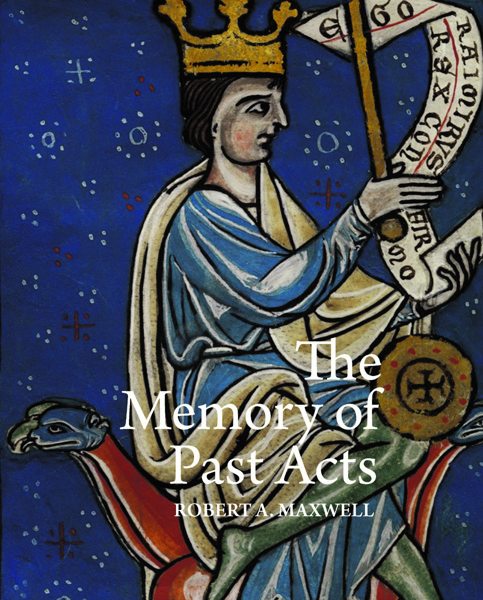
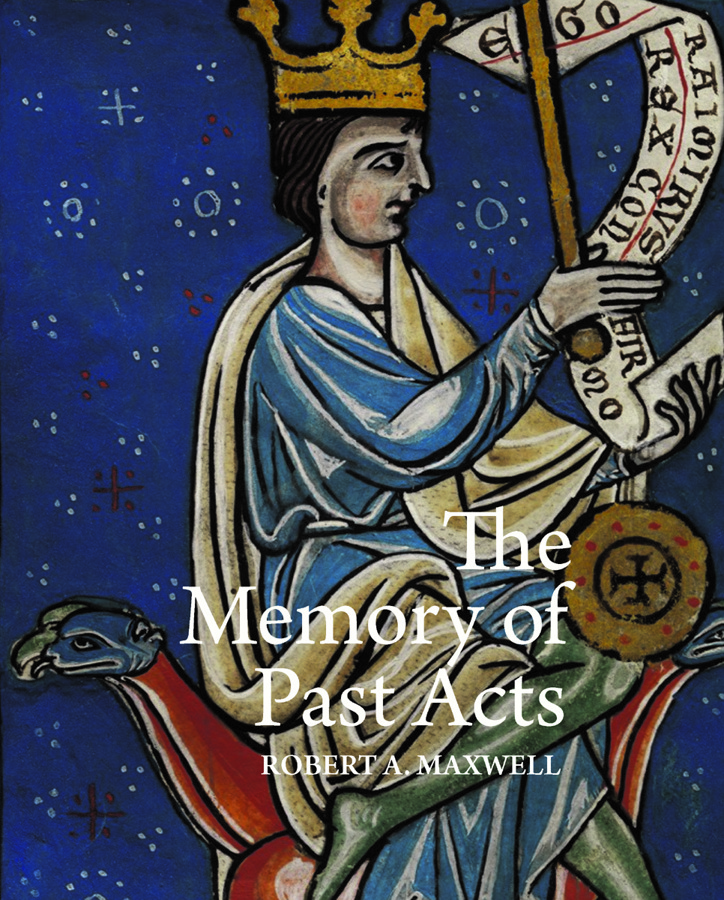
For much of the Middle Ages, agreements over properties, rights, and obligations were recorded on individual sheets of parchment. Cathedrals, monasteries, and royal chanceries accumulated hundreds of such records, or charters. Increasingly by the eleventh century these institutions took to recopying them into manuscripts, or cartularies. Copied collections of legal agreements would not seem to invite decoration or embellishment; yet around three dozen illuminated cartularies survive from the period from around 1050 to 1220. This book offers the first sustained analysis of some thirty surviving such works from across western Europe and their highly inventive imagery.
The brilliantly colored illuminations depict miracles, royal power, and, most strikingly, images suggestive of the culture of documents and of scribal mises en abîme. Scenes that set charters and various performances associated with written agreements serve to highlight memorial attitudes toward past legal acts and testify to an expansion of the visual culture of documentary practice.
The special character of cartularies as copied collections also encourages reconsideration of art history’s usual iconographic pursuits. The Memory of Past Acts privileges the process of manuscript production as central to the imagery. It argues that discourses surrounding scribal and textual traditions (copying, transcribing, displacing originals, reinventing authority, writing history) not only inform the subjects depicted, but also, and more fundamentally, motivate the very inclusion of illumination, making such imagery nothing less than a meditation on past scribal acts.
Preface
Conventions and Abbreviations
List of Figures
Introduction
1 Documentary Residue
2 Sealing into History
3 Memorializing the Charter
4 Thematizing the Medium: Charter to Codex
5 Dream Work, From Archive to History
Conclusion
Appendix: List of Illuminated Cartularies to c. 1220
Notes
Bibliography
Index of Manuscripts Cited
General Index