Disease and Disability in Medieval and Early Modern Art and Literature
View publication
"The bibliography is impressive (...) and the substantial index (thematic and personal names) should receive special mention, as these aspects are often neglected or simply absent in a collection of essays. These, and the thematic coherence of the volume as a whole, are clear indication of a very well thought-out volume, for which both editors and contributors should be congratulated." (Denis Renevey, in: Francia-Recensio, 2013/2)
"(...) le présent volume ouvre la voie à une approche à la fois plus critique et plus englobante de la pensée "médiévale", (...)" (Jules Janssens, dans: Bulletin Critique des Annales Islamologiques, Vol. 28, 2013, p. 106-108)
"The high calibre of the contributors, and the competence of the editors in their respective languages and subjects ensures the reliability of this collective volume. The cumulative bibliography and comprehensive index, which includes subject matter alongside proper names reflect the coherence of the volume and the interpenetration of the studies it contains. Altogether the reader is richly rewarded by new research, elegantly and accurately presented." (Charles Burnett, in: The Medieval Review 14.10.14)
"This collection of studies on the transmission of knowledge and culture in the Middle Ages is a welcome contribution to the fields of textual criticism, philology, and history, raising timely theoretical questions and showcasing an impressive diversity of scholarship. (...) Overall, the volume is a solid achievement, broad in scipe and admirably reaching out across disciplines. It is encouraging to think that the research group at the helm of this project will continue its valuable work in organising workshops and publishing scholarship." (Samuel England, in: Al-Masāq, 2014, Vol. 26, No. 2, p. 224-226)
"Wij kunnen alleen maar verhopen dat - ongetwijfeld mede dankzij deze bundel - een dynamischer model voor de culturele en wetenschappelijke uitwisseling tussen culturen in een gegeven periode ontwikkeld zal worden." (Jules Janssens, in: Tijdschrift voor Filosofie, 76/2014, 3, p. 593-595)
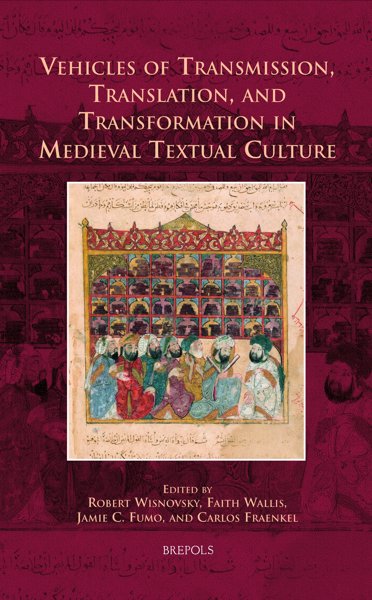
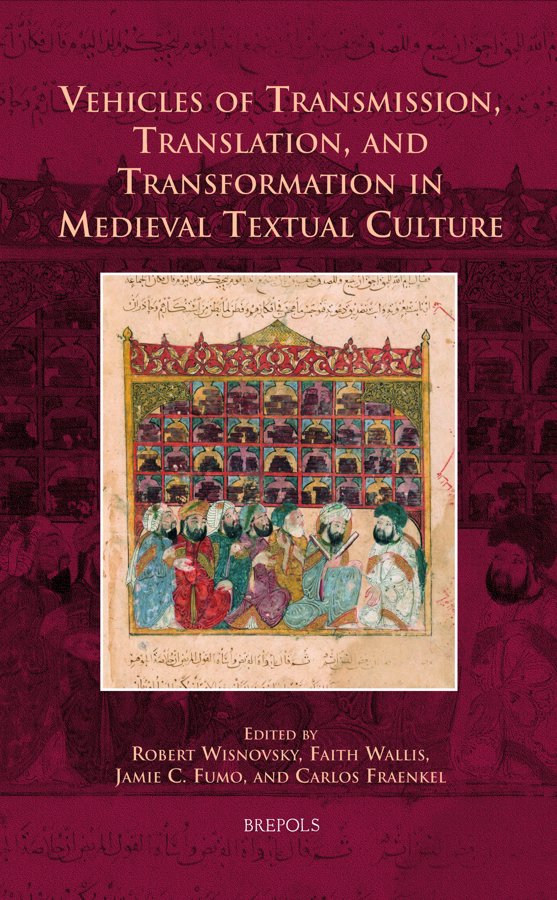
In this volume the McGill University Research Group on Transmission, Translation, and Transformation in Medieval Cultures and their collaborators initiate a new reflection on the dynamics involved in receiving texts and ideas from antiquity or from other contemporary cultures. For all their historic specificity, the western European, Arab/Islamic and Jewish civilizations of the Middle Ages were nonetheless co-participants in a complex web of cultural transmission that operated via translation and inevitably involved the transformation of what had been received. This three-fold process is what defines medieval intellectual history. Every act of transmission presumes the existence of some ‘efficient cause’ – a translation, a commentary, a book, a library, etc. Such vehicles of transmission, however, are not passive containers in which cultural products are transported. On the contrary: the vehicles themselves select, shape, and transform the material transmitted, making ancient or alien cultural products usable and attractive in another milieu. The case studies contained in this volume attempt to bring these larger processes into the foreground. They lay the groundwork for a new intellectual history of medieval civilizations in all their variety, based on the core premise that these shared not only a cultural heritage from antiquity but, more importantly, a broadly comparable ‘operating system’ for engaging with that heritage. Each was a culture of transmission, claiming ownership over the prestigious knowledge inherited from the past. Each depended on translation. Finally, each transformed what it appropriated.
Acknowledgments
List of Illustrations
Introduction. Vehicles of Transmission, Translation, and Transformation in Medieval Textual Culture — ROBERT WISNOVSKY, FAITH WALLIS, JAMIE C. FUMO, AND CARLOS FRAENKEL
Integrating Greek Philosophy into Jewish and Christian Contexts in Antiquity: The Alexandrian Project — CARLOS FRAENKEL
Theophrastus, Alexander, and Themistius on Aristotle’s De anima III. 4–5 — SARA MAGRIN
The Universal Chronicle in Antiquity and in the Middle Ages — HERVÉ INGLEBERT
The Heritage of Jewish Apocalypticism in Late Antique and Early Medieval Judaism, Christianity, and Islam — GERBERN S. OEGEMA
Prolegomena as Historical Evidence: On Saadia’s Introductions to his Commentaries on the Bible — SARAH STROUMSA
Towards a Natural-History Model of Philosophical Change: Greek into Arabic, Arabic into Latin, and Arabic into Arabic — ROBERT WISNOVSKY
Abbreviation in Medieval Latin Translations from Arabic — DAG NIKOLAUS HASSE
Why Was the Aphorisms of Hippocrates Retranslated in the Eleventh Century? — FAITH WALLIS
Arabic into Greek: The Rise of an International Lexicon of Medicine in the Medieval Eastern Mediterranean? — ALAIN TOUWAIDE
The Introductions of Thirteenth-Century Arabic-to-Hebrew Translators of Philosophic and Scientific Texts — STEVEN HARVEY
Secondary Forms of Philosophy: On the Teaching and Transmission of Philosophy in Non-Philosophical Literary Genres — JAMES T. ROBINSON
Hasdai Crescas’s Aristotle: Transmission, Translation, Transformation — WARREN ZEV HARVEY
Avicenna’s ‘Vague Individual’ and its Impact on Medieval Latin Philosophy — DEBORAH L. BLACK
William of Thiegiis and Latin Commentary on the Metamorphoses in Late Medieval France — FRANK T. COULSON
Ovid’s New Clothes: Text and Image in Caxton’s ‘Booke of Ouyde’ (1480) and Contemporary Prose Moralizations of the Metamorphoses — JAMIE C. FUMO
Monastic Manuscripts and the Transmission of the Classics in Late Medieval England — JAMES G. CLARK
Greek Roots, Arab Authoring, Latin Overlay: Reflections on the Sources for Avicenna’s Canon — RAPHAELA VEIT
Bibliography
Index