Crusading in Frankish Greece
View publication
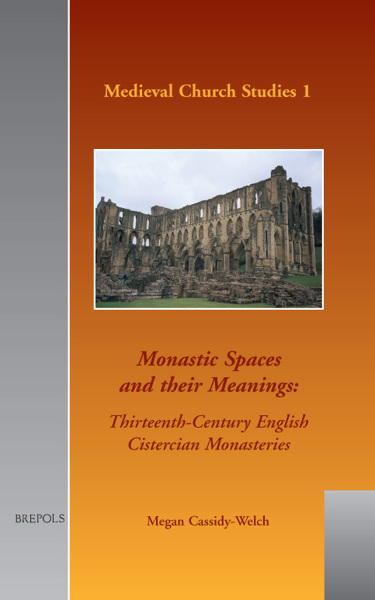
The author focuses on the Cistersian abbeys of northern England during the period 1132-1400, and supplies a microhistory of cultural, textual, personnel and architectural comparisons.
"This book breaks exciting new ground in monastic scholarship and will be of interest to scholars of medieval religion in a variety of fields." (N.B. Warren in Parergon 20.1, 2003, p.205)
"This is a most stimulating, thought-provoking interpretation that will be required reading for all historians of medieval monasticism." (B. Golding in The American Historical Review, october 2003, p. 1205)
"By taking a different line of approach with strong emphasis upon local contemporary literature, she has given fresh insights into monastic life, its thought and its meaning." (L. Butler in Review in Yorkshire Archaeological Society, vol. 15, 2003, p. 225)
"This study is al welcome addition to the literature on Cistercian monastic culture, and successfully blends textual and material sources." (J. Burton in English Historical Review, CXVIII. 475, february 2003, p. 138)
"It should prove a stimulating enterprise that architectural theorists will read with profit." (N. Wu in CAA Reviews, April 2003)
"This is an important book for any study of the Cistercian Order in its early centuries. The twenty-seven-page Bibliography is a rich reference library in itself." (J. Holman in Cistercian Studies Quarterly, vol. 39.2, 2004, p.215-217)
Dr Cassidy-Welch is a fellow of the History Dept. at the University of Melbourne.
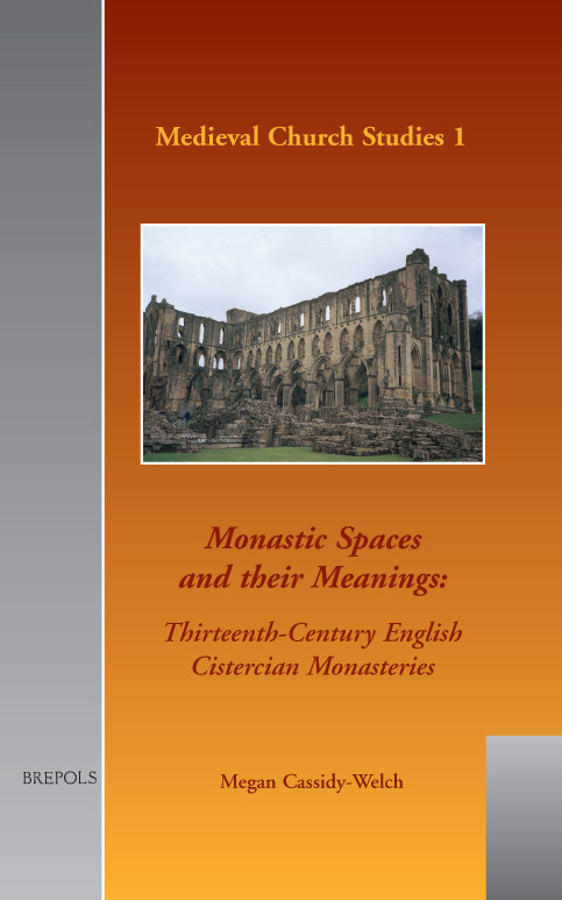
Medieval Cistercians distinguished between material and imagined space, while the landscapes in which they lived were perceived as both physical sites and abstract topographies. Ostensibly, Cistercians lived in intensely regulated and confined physical circumstances in accordance with ideals of enclosure articulated in the Regula S. Benedicti. However, Cistercian representations of space also express ideas of transcendence and freedom. This monograph focuses on the abbeys of northern England during the period 1132-1400 (Fountains, Rievaulx, Jervaulx, Meaux, Sawley, Roche, Byland and Kirkstall) to facilitate a microhistory of cultural, textual, personnel and architectural comparisons. Post-twelfth century Cistercian history has been understudied, in comparison with research into the euphoria of the order's foundation, and has tended to focus on 'ideals' versus 'reality', whereas this study considers Cistercian houses in terms of contingency, singularity and specificity. The author engages with the work of theorists such as Michel Foucault, Pierre Bourdieu and Henri Lefebvre, all of whom have explored the cultural production of space and the meanings attributed to certain spaces by abstract reference, performative practice and institutional direction. The study is richly illustrated with 45 images of the landscape and space of these houses and enables the reader to see how one monastic order positioned itself in relation to geography, architecture, institution, community and cosmos, and dealt with the dialectic between regulation and imagination, freedom and enclosure. Patrick Geary (UCLA) commends this study as being 'based on a wide reading of Cistercian texts and blends solid text-critical historical scholarship with more conceptual approaches in a most convincing way'.