
Making the Profane Sacred in the Viking Age
View publication
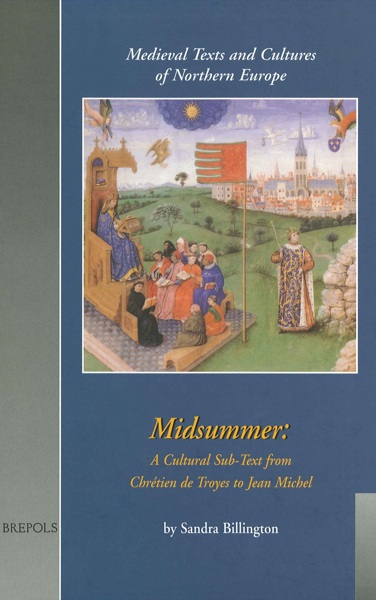
This publication is based on new and original research from archives in France and the Low Countries, concerning customs and beliefs practised around the midsummer solstice in the twelfth and thirteenth centuries.
"(...) Billington's monograph shows a great amount of background reading and adds significantly to our impressions of and knowledge about the Middle Ages in France, its literature (theater), and culture. The book can even be recommended to undergraduates." (E. DuBruck in Fifteenth-Century Studies, 31 (2005), p.7-12)
This book is based on fresh and original research from archives in France and the Low Countries, concerning customs and beliefs practised around the midsummer solstice. The information has never previously been considered and it reveals a festive treatment of divisiveness, which might also be politically engaged. The book shows how in the twelfth and thirteenth centuries these traditions were not solely observed by the lower classes. A study of texts throughout the Middle Ages shows that the significance of St John's Day was a valued source for some major writers, and it can be argued that it was even the rationale for works such as Chrétien's Yvain, and the anonymous Perlesvaus. The midsummer customs also appear in the civic records of Leuven and Metz, in periods where the city authorities were strong enough to break free of feudal controls. Their civic freedom was expressed at the Feast of the Baptist's Nativity, and this appropriation by the bourgeoisie informs the romance, Galeran. The rationale of Midsummer is to examine the disparate, but interlinked uses of the customs, and to bring to the awareness of scholars festive influences current in Europe before the better known influence of Carnival; also to discuss their seminal importance for early fiction and for the theatre. The book further reveals that pre-Christian belief in Chance / Fortune was supported by the phenomenon of the Solstice and that John the Baptist's Nativity, placed on 24 June, provided a way for Christian Fathers to allow for this, safely. [Sandra Billington is a Reader at the University of Glasgow.]