

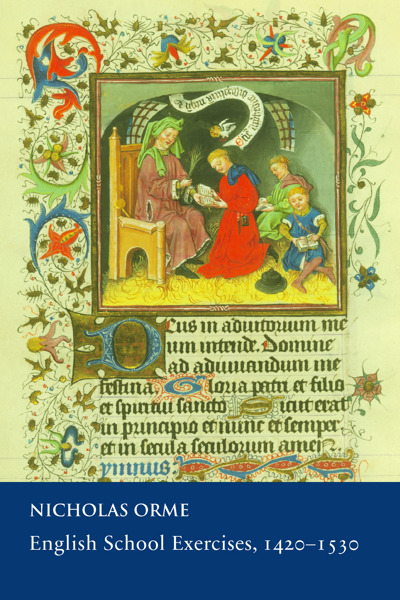
English School Exercises, 1420–1530
View publication
This book examines the cult of an eastern saint in the medieval Latin West, bridging traditional linguistic and geographical boundaries in the study of early medieval Europe. The movement of the cult of Anastasius the Persian monk (d. 22 January 628 in Kirkuk, modern Iraq) from Persia, Jerusalem, and Constantinople to Rome and Italy in the mid-seventh century, and from there to Anglo-Saxon England and northern Europe, is documented by an extensive literary dossier, as well as by the veneration of the martyr's relics and other evidence of liturgical commemoration. The book surveys the cult's historical beginnings in the East, and its early development in Rome within the context of the city's Greek-speaking population and the religious controversies of the seventh and eighth centuries. The entire Latin literary tradition of the cult of Anastasius goes back to two Greek texts (one composed in Jerusalem, the other in Rome itself) that were translated into Latin in Rome, the most important centre of cultural exchange between Greek and Latin in the period. The Latin dossier's relationship to the Greek texts affords us the almost unparalleled opportunity to observe early medieval translators at work and to understand more fully their tools, methodologies, and motivations at a time when the knowledge of Greek and its literary culture was in sharp decline in the West.
The second part examines the diffusion and metamorphoses of the Latin dossier of Anastasius as a case-study of the fluidity of hagiographic works. Among the most significant of these revisions is one that may be identified with a lost work of Bede. Critical editions of ten texts are included.