The Politics of Exclusion in Early Renaissance Florence
View publication
"Amsler has an impressive historical grasp ranging from classical antiquity to the Early Modern period and spanning most of Europe from England through Flanders to Italy, though the focus is on England and northern Europe. The volumes's scope is wide, both in terms of theoretical breadth and in terms of the material cited. Examples are drawn from a wide range of literary, documentary, and visual artifacts (...). If nothing else, the volume is thoroughly researched and draws on an extensive background knowledge of both medieval history and modern and medieval critical theory." (Sif Rikhardsdottir, in: Journal of the English and Germanic Philology, April 2014, p. 236-237)
"(...) the volume as a whole is a fine illustration of how a socio-linguistic approach can bring together disparate material to restore complexity and thereby enhance our appreciation of literacy in the late Middle Ages." (Rachel Yuen-Collingridge, in: Parergon, 31.2, 2014, p. 137-139)
"[The book's] arguments are buttressed by a wide range of linguistic, sociological, and philosophical writings, as well as the kind of literary-critical and historical scholarship with which most medievalists are likely to be more familiar. Those prepared to stay the course will be rewarded with serious insights into the nature of medieval multilingual literacy." (K. Busby, in: Bulletin codicologique - Scriptorium, 2014/01)
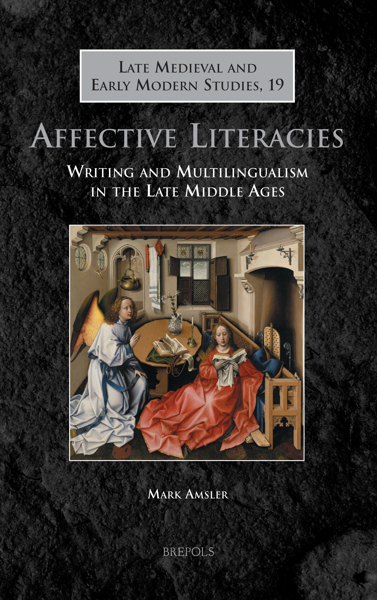
New Literacy Studies, close reading, and historical sociolinguistics inform Amsler's analyses of late medieval writing and textual cultures. Amsler argues that medieval reading and writing make sense not as individual expressions with discrete texts but as multilingual, sociocultural, and intertextual practices that 'make people up' and that sustain or challenge dominant ideologies and reading formations. Rather than a single Literacy, we find socially situated literacies within manuscript matrices. Bringing new historical dimensions to literacy studies, Amsler explores the intertextualities, affective relations, and social contests in these multilingual formations. Individual chapters examine literacies as cultural practice in schooling and in elite and popular texts by Chaucer, Christine de Pizan, Dante, Margery Kempe, devotional writers, Erasmus, and the Jewish convert Hermann von Sheda, along with grammatical writing, mythography, charms, drama, and educational texts. This volume illustrates the diversity of late medieval multilingual writings,textual performances, and embodied readings.
Dr Mark Amsler is senior lecturer at the Department of English of the University of Auckland, New Zealand.
Introduction
Chapter 1. Theorizing Medieval Literacies
Chapter 2. Language Ideology and Marginal Latins
Chapter 3. Affective Literacies
Chapter 4. Reading Assimilation and Jewish Latin Textuality
Chapter 5. Ovid’s Mythography and Medieval Readers
Chapter 6. Grammar of Unruly Latin in Middle English Writing
Chapter 7. ‘Clean and Chaste Latin’: Literacy, Humanism, and the Boy Jesus
After Words
Bibliography
Index nominum
Index rerum