Introducing the Lambeth Bible. A Study of Text and Imagery
View publication
"This volume will be indispensable to historians of Byzantine manuscript illuminations and scholars interested in the history of reception of Job."
(L. Seow, in: Studies in Iconography, vol. 32, 2011, p. 235)
“Ce magnifique ouvrage se recommande d’emblée a l’attention par un trait excessivement important pour ce type d’études: la grande majorité de ses illustrations sont en couleurs, et d’une grande qualité, ce que se révèle extrêmement utile étant donné le pauvre état de conservation dans lequel nombre d’enluminures nous sont parvenues. Qui est plus, elles sont le plus souvent présentées en regard, ce qui en facilite la comparaison. Un bel ouvrage, donc, publie à titre posthume, la maladie n’ayant pas permis à l’A. d’assister à la parution de son opus.” (Véronique Somers, dans la Revue d’Histoire Ecclésiastique, 2016, p. 246)
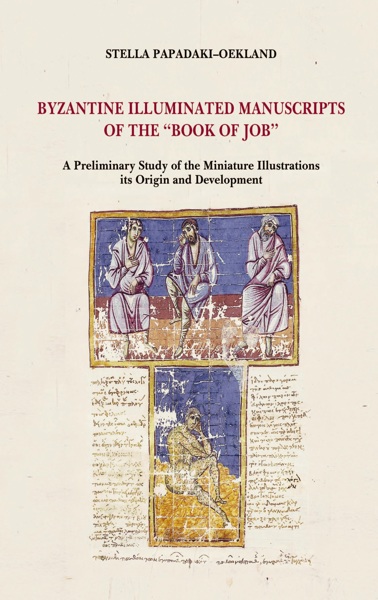
Of all the Old Testament books, the Book of Job remains acutely contemporary today. Written between the 6th and 3rd c. B.C., it deals with subjects such as the presence of evil in the world, the misery, the quest for justice, the faith, and the behavior of people when they face sudden twists and turns of life. It seems that the ancient text had been illustrated since the Early Christian period because of its fascinating novel-like narrative style.
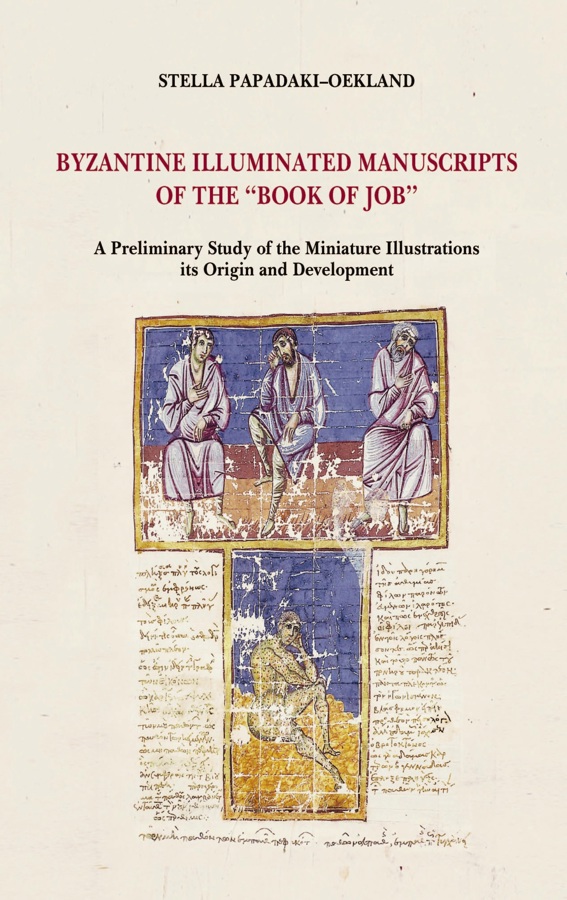
In her own study on the Book of Job, Stella Papadaki-Oekland probes into all the Byzantine illuminated manuscripts of the illustrated Greek text. The number of miniature illustrations included in these fifteen manuscripts, dating from the 9th to the 16th century, comes to more than 1800 of which 2/3 of the about 380 illustrated herein are previously unpublished manuscript images. The book is an unabridged version with minor changes of Papadaki-Oekland’s Inaugural Dissertation at Heidelberg University (1979) and is published posthumously by her daughters, Helen-Aina and Astrid-Zoé -in homage to Byzantine Art.
The fifteen Byzantine Illuminated Manuscript Illustrations of the “Book of Job” studied, illustrated and discussed are: Biblioteca Apostolica Vaticana, Rome: cod. Vat. gr. 749; cod. Vat. gr. 751; cod. Vat. gr. 1231 and cod. Vat. Pal. gr.230 - The Monastery of St. John the Theologian, Isle of Patmos: cod. Patmos 171 - Biblioteca Nazionale Marciana, Venezia: cod. Marc. gr. 538 - Monastery of St. Catherine, Sinai, Egypt: cod. Siena 3 - Orthodox Patriarchate of Jerusalem and All Palestine, Jerusalem: MS. Taphou 5 - Monastery of Vatopedi, Mount Athos: Vatopedi 590 - Monastery Magisti (Great) Lavra, Mount Athos: Lavra B100 - Byzantine and Christian Museum, Athens: MS. 62 - Bodleian Library, Oxford: MS. Barocci 201 and MS. Laud gr. 86 - Bibliothegue nationale de France, Paris: MS. gr. 134 and MS. gr. 135 - National Library of Russia, St. Petersburg: MS gr. 382 (former folio of Taphou 5)
The study of the Septuagint Book of Job in Byzantine tradition include comparative analysis of the interrelationship of the individual miniature cycles, their general arrangement and artistic character, the origin and development as well as its contents and significance in the literary and popular tradition. Finally, the six Comparative Tables presented at the end of the volume provide the reader for the first time a complete cross reference interrelationship between the individual 1800 images of the 15 manuscripts and “Sir Lancelot C. L. Brenton’s” English translation of the Septuagint “Book of Job” passages.
Further examples of images discussed herein of early Christian “Job” representations include: Biblioteca Apostolica Vaticana, Rome, MS.Reg.gr.1 – known as the Bible of Queen Christina of Sweden; Bibliothèque nationale de France, Paris, MS gr. 510, MS syr. 341-the Syriac Bible and MS.gr. 923- Sacra Parallela; Biblioteca Nazionale “Vittorio Emanuele III”, Naples, Coptic MS IB 18, Catacomb of the Via Latina, Rome and the Sarcophagus of Junius Bassus, Basilica di San Pietro, Rome.
Furthermore, the book is of invaluable importance due to its methodological approach. As the leading art historian Hans Belting points out, the study of Stella Papadaki-Oekland calls in question Kurt Weitzmann’s rigid theory about the process of the Byzantine illuminated manuscripts production.
There’s no doubt that, even though it was written a lot of years ago, this remains the most complete and comprehensive study about the Book of Job in Byzantine art.