Masculinities and Femininities in the Middle Ages and Renaissance
View publication
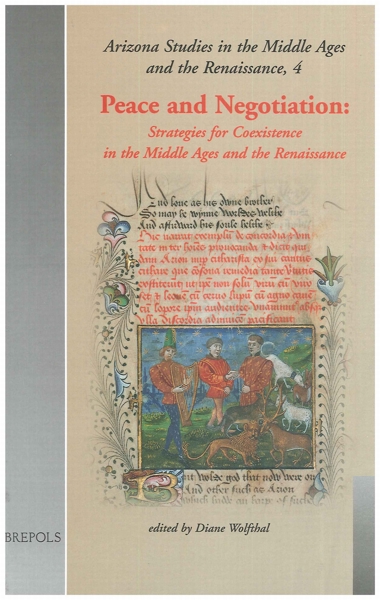
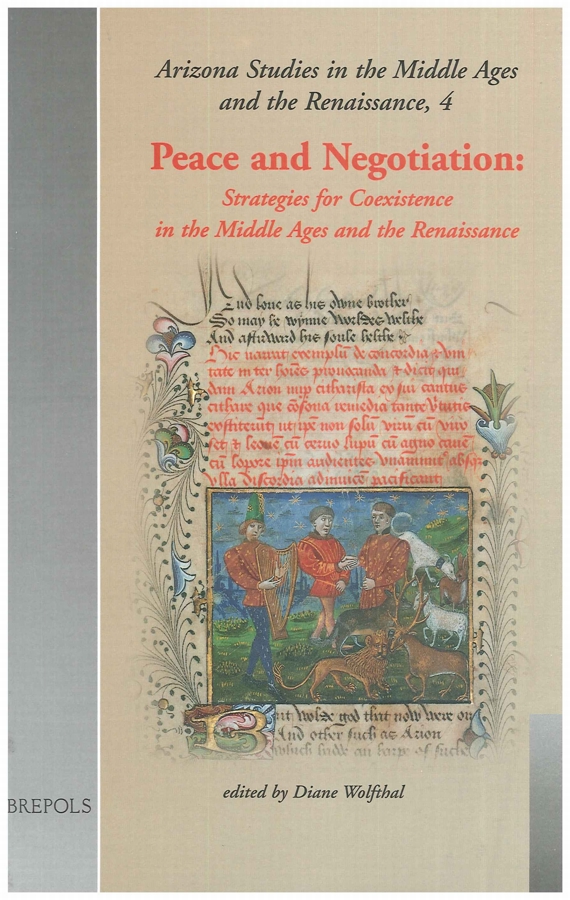
The articles in this volume cover a broad range of disciplines, times, and geographical areas and explore strategies that were used in the Middle Ages and Renaissance to resolve conflict and attain peace, a concept at times constructed as a rich and complex, positive and dynamic ideal.
"(...) a wide-ranging and erudite collection of essays on peace in the pre-modern world." (M. Cassidy-Welch in Parergon, p. 251-252)
Peace was far from a pale, static concept - a simple lack of violence - in the Middle Ages and Renaissance. Rather, it was at times constructed as a rich and complex, positive and dynamic ideal. The thirteen articles in this volume cover a broad range of disciplines, times, and geographical areas and explore strategies that were used in the past to resolve conflict and attain peace. They examine events, texts, and images that date from the fifth through the sixteenth centuries, and their authors focus not only on Western Europe, but also on Scandinavia, the Caucusus, and Egypt. This volume rests on the assumption that peace covers a spectrum of situations that connects the personal and the political. Therefore, the papers presented here examine not only how nations negotiated peace, but also how individuals did. Similarly, although several essays spotlight those in the seat of power, others explore those who are politically marginalized. our views about peace and conflict, as this collection makes clear, are shaped in part by the mentalités of the past. Although some peacemaking strategies may be unacceptable to us today - forced marriages and conversions, for example - we can learn from other strategies how to transcend or modify various modes of antagonistic thinking.
D. Wolfthal; Introduction
M. W. Herren; Negotiating settlements in half-Christianized societies: the case of early medieval Ireland
L. Eshleman; Weavers of war, weavers of peace
R. Lavelle; Towards a political contextualization of peacemaking and peace agreements in Anglo-Saxon England
J. Edward Damon; Advisors for peace in the reign of Æthelred the Unræd
J. Wilcox; The St. Brice's Day massacre and Archbishop Wulfstan
C. S. Pendergast; Outside the walls: jurisdiction and justice on a gateway at Anzy-le-Duc
K. M. Christensen; The conciliatory rhetoric of mysticism in the correspondence of Heinrich von Nördlingen and Margaretha Ebner
L.S.B. MacCoull; The Rite of the Jar: Apostasty and Reconciliation in the Medieval Coptic Orthodox Church
S. H. Rapp JR.; Christian Caucasian Dialogues: Glimpses of Armeno-K´art´velian Relations in Medieval Georgian Historiography
B. Lowe; A War to End All Wars? Protestant Subversions of Henry VIII´s Final Scottish and French Campaigns (1542-45)
C. Skenazi; Dispositio as an Art of Peace in Ronsard´s Poetry
S. Ffolliott; Make Love, Not War: Imaging Peace through Marriage in Renaissance France
N. J. Efron; Common Goods: Jewish and Christian Householder Cultures in Early Modern Prague